
First line(s) from the books on one of my shelves, selected entirely randomly. (This is only counting the books you can see; my bookshelves runneth over.)
1. Perhaps it was merely the book she was reading, but Sarah Petursson felt uneasy.
2. London. Michaelmas Term lately over, and the Lord Chancellor sitting in Lincoln's Inn Hall. Implacable November weather.
3. He was lost. He wasn't used to being lost. He was the kind of man who drew up plans and executed them, but now everything was conspiring against him in ways he decided he couldn't have foreseen.
4. The ice was thin and loosely attached to the rock. I could see water streaming beneath the opaque layer undermining its strength.
5. Behold! I am not one that goes to Lectures or the pow-wow of Professors.
6. It is quite true that I wasn't doing anything that morning except looking at a blank sheet of paper in my typewriter and thinking about writing a letter. It is also quite true that I don't have a great deal to do any morning. But that is no reason why I should have to go out hunting for old Mrs. Penruddock's pearl necklace. I don't happen to be a policeman.
7. 'Resurrection, like politics, makes strange bedfellows', Sam Clemens said. 'I can't say that the sleeping is very restful.'
8. The Animal Tales collected in this group of folk narratives are not animal anecdotes, nor tales of magical animals such as we find in the Fairy Tales.
9. It was on a mild, fragrant evening in late September, several weeks after she had moved to Glenkill, Pennsylvania, to begin teaching at the Glenkill Academy for Boys, that Monica Jensen was introduced to Sheila Trask at a crowded reception in the headmaster's residence.
10. At first, the damage didn't look quite that bad. There was a jagged crack running through the front door's glass, but that could have happened in a hundred innocent ways.
11. When the big man came in, there was a movement in the room like a lot of bird dogs pointing. Piano player quits pounding, the two singing drunks shut up, all the beautiful people with cocktails in their hands stop talking and laughing.
12. Imagine for a moment that, once Spectre had been safely defeated by Sean Connery, they turned the set of You Only Live Twice into a theme park - with a sliding roof over an artificial beach. Imagine they also put in a wave machine and heated the whole thing up to a steady 30 degrees centigrade.
13. Derek Strange got down in a three-point stance. He breathed evenly, as his father had instructed him to do, and took in the pleasant smell of April.
14. I leave these verses as they stand, although they contain innumerable examples of what I now see to be errors of literature, and one or two examples of what I have come to think errors of opinion.
15. It was my liver that was out of order. I knew it was my liver that was out of order, because I had just been reading a patent liver-pill circular, in which were detailed the various symptoms by which a man could tell if his liver was out of order. I had them all.
16. The ideological roots of Socialist feminism lay in the popular democratic tradition of the late eighteenth century, and in particular in the radical egalitarianism of the 1790s.
17. And so let us beginne; and, as the Fabrick takes its Shape in front of you, alwaies keep the Structure intirely in Mind as you inscribe it.
18. It was a bright cold day in April, and the clocks were striking thirteen.
19. When Sean Devine and Jimmy Marcus were kids, their fathers worked together at the Coleman Candy plant and carried the stench of warm chocolate back home with them.
20. Observe now your own epoch of history as it appears to the Last Men.
21. Light came through the window, trickling morning all over the room. Tatiana Metanova slept the sleep of the innocent, the sleep of restless joy, of warm, white Leningrad nights, of jasmine June.
22. Nothing but stars, scattered across the blackness as though the Creator had smashed the windscreen of his car and hadn't bothered to stop to sweep up the pieces.
23. "We should start back," Gared urged as the woods began to grow dark around them.

Because January pay is bad pay, I am gathering together books to sell.
This makes the situation sound a bit on the melodramatic side. I will start again.
Because January pay is bad pay, and because I'm still at my parents' house along with all of my books that don't live in mine, and because it's occurred to me that books I have lived without for five years are probably books I don't need, I am gathering together books to sell. Most of them are Philosophy textbooks from my undergrad years, and I can't justify hanging onto them for any reason beyond liking the subject. When I can get around £15 per book for six books on Amazon Marketplace, I can't afford to like the subject.
However. However. Can I justify holding on to my best secondhand bookshop find ever? It cost me £12 for the set, nearly new, and £12 is a lot, really, but I picked it up because I thought that Lives of Victorian Literary Figures looked like the kind of thing I'd appreciate having on my bookshelf in years to come. Plus, there's a lot of rare material here. Plus, I love this series. So I bought it, and then I idly Googled it a few days later to find out if Part II would ever be within my financial reach, and then I blinked at the screen in silence for a while, and then I carefully moved the books to a less precarious shelf.
I mean, I'm broke. Very broke. I have no guaranteed teaching for next semester, and no guaranteed work of any sort for the summer. I can just about afford the rent on my flat. Can any academic investment justify keeping hold of a three-book set I could get £200 for on Amazon or AbeBooks?
But maybe, by letting me find them as I did, the whimsical fates of academia were giving me a chance to own books I couldn't have afforded new. It's probably bad luck to turn down good luck like that.
And maybe, by letting me find them as I did, the whimsical fates of academia were giving me £200.
The debate rages on inside my head. For now, they stay on the bookcase.
"You bring up your girls as if they were sideboard ornaments, and then complain of their frivolity."
I wouldn't usually suggest looking to John Ruskin for the basics of a non-sexist education system. But here we are today, wise and enlightened and knowing so much better than People Back Then did etc. etc. and whatever else we tell ourselves, and here we are still dividing up reading lists for 14-year-olds into girl books and boy books.
You can see the list of suggestions from the teaching resource site here (it's a PDF file). Girls get, among other things, Amy Tan's The Bonesetter's Daughter, H. E. Bates's The Darling Buds of May, Tracy Chevalier's Girl with a Pearl Earring, Alice Sebold's Lovely Bones, and a bunch of Joanne Harris novels (Chocolat, Five Quarters of the Orange, Blackberry Wine). Boys get Bernard Cornwell's Sharpe books, Terry Pratchett's Discworld books, Tolkien's The Hobbit and The Lord of the Rings, Nevil Shute's A Town like Alice, Ernest Hemingway's Death in the Afternoon and Julian Barnes's A History of the World in 10 1/2 Chapters.
Hmm.
Okay, this isn't about demanding that children adhere to strict gender roles. This is just about letting them read things they'd be interested in. Right? After all, young teenagers are very adept at segregating themselves into single-sex friendship groups without adult involvement, and the gap between what male students and female students are achieving at GCSE level (and most other levels of primary and secondary education) is a real one. It's only been a real one since the 1970s, but I am led to believe this is just extra extra evidence of how it owes its existence to irreconcilable biological differences first ingrained in our ancestors several million years ago. (Okay, to be fair - the argument is actually that the post-1970 education system has been 'feminised' and now favours female traits like empathy. Why yes, my A-level Chemistry classes were all about writing essays on how it feels to be potassium chloride.) Girls are just interested in different things, and there's nothing we can and nothing we should do about it.
I don't believe that, but let's go with it for a moment anyway. Assume that the suggested-reading list is entirely descriptive, not prescriptive, and that it merely reflects what fourteen-year-olds are more likely to be interested in.
I read Nevil Shute's A Town Like Alice when I was 14, and loved it, literally, to pieces - my paperback copy fell apart in my hands during one of the many re-reads. Loved it enough to roll my eyes at the English teacher who said "Oh, because it's a love story?". Loved it enough to nearly miss a "Boarding NOW, no REALLY!" call at an airport last year, after finding another copy in a secondhand bookshop in the conference town. Loved it that much.
It's not perfect. It was written in 1950, and there are lines that remind you of that in a particularly uncomfortable way, the kind of lines that would, if the book was a party and all the lines were guests, leave you not only walking away from them without reply but discussing them in hushed tones to other guests at other parties for years afterwards. But it's great, and it's the only book on either of those lists that I loved because I was a 14-year-old girl, rather than independently of the fact.
It's about a young British woman living in occupied Malaya during the Second World War, part of a group of women and children marched around the island for years at a time because there aren't any prison camps for them. She survives, negotiates a deal with the elders of a tiny mountain village, and spends the rest of the war working in the rice-fields in exchange for the party's food and shelter. After the war, she moves back to England, learns she's inherited a large sum of money from an elderly relative, moves to the Australian outback to find the POW she met in Malaya, and uses her inheritance to make the tiny, depressed town he comes from into a place where people could live and work. And the book's narrated by the lawyer who still holds her inheritance in trust, because the relative who died didn't believe women were responsible enough to handle their own finances until at least the age of 35.
So. Do you think it's in the 'For Boys' list because the designer of that list gave it to a representative sample of male and female students, carefully weighed their responses against a backdrop of gender expectations and stereotypes, and decided accordingly; or because someone, somewhere, went "Oh, this one's about war. War's a boy thing"?
So to return to Ruskin, who wrote Sesame and Lilies fifty years before compulsory secondary education in England and Wales was even introduced:
Keep the modern magazine and novel out of your girl's way: turn her loose into the old library every wet day, and let her alone [...] Let her loose in the library, I say, as you do a fawn in a field. It knows the bad weeds twenty times better than you; and the good ones too, and will eat some bitter and prickly ones, good for it, which you had not the slightest thought would have been so.
We've come so far.
Penguin are running a design-your-own-cover project for seven of their classic titles (Amy, this sounds like your sort of thing), and have asked some folks in the music business to try their hand at it. (Only a few, though, which is a shame. Now I'll never know what McFly would have done with Anna Karenina.) Ryan Adams chose Dracula, and you can see his cover here.
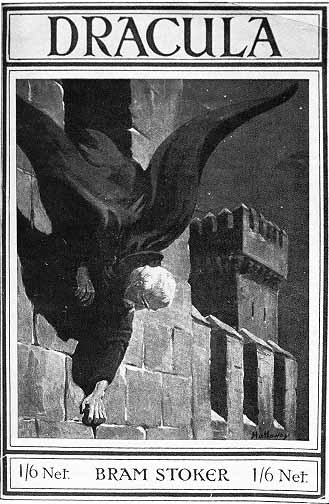
Yes. It's very... oil-painted, isn't it? And quite, um, orange. Maybe Castle Dracula was built on sandstone. (Not, I should point out, that I want to criticise the supremely talented Mr. Adams, who I've loved since back when he was the singer in Whiskeytown. I love McFly, too, but for completely different reasons. They're just so sweet.) But it's interesting that neither Ryan Adams nor anybody else depicted a scene from the novel itself. The best-known Dracula cover is, I'm guessing, this one, illustrating one of the most famous images in the story (and managing to solve the problem of how it's possible to crawl down a castle wall without one's cloak falling over one's head, too: convenient up-draft). Most of the modern editions go for visual representations of characters or scenery.
I had half a theory that the earlier editions concentrated on vampires or Transylvania while the more recent ones emphasised something about Victorian England instead (compare, for example, this 1902 cover ('Joseph of Arimathea meets White Fang') with the more recent Broadview edition), but I don't think that's the case, either. And even Ryan Adams, who told the Guardian that the novel's all about "how suffocating the Victorian times were", picked the Transylvanian castle for his cover. (Actually, in his own words: "Dracula's headquarters, his hang." Ryan, I still love you, but we need to talk.)
Books we associate with a particularly strong visual image seem to come packaged with that image on the front a great deal of the time. I doubt it's a coincidence that the Dracula editions tend to go for Dracula greeting Jonathan (who isn't usually in the picture), Dracula climbing down the wall, or the shape of the castle itself. A lot of that, I'm guessing, has to do with the most striking scenes of the various Dracula films - even if you don't have Bela Lugosi or Christopher Lee on your cover, everyone knows that's what Dracula looked like when he met Jonathan for the first time - but there's more to it than that, I think. And while I don't know nearly enough about the history of the publishing industry to take any guesses at why cover illustrations of particular books tend to be more abstract (or at least, less likely to illustrate an image described in the story itself) than they used to be, I do think it's interesting that the front covers which show a grinning Dracula or a many-turreted castle seem less literary than the ones which show blurry figures or swirly oil-painted outlines of buildings.
(That said, there's no guarantee that our most vivid visual impressions of a novel will turn out to be something represented within it. Take the recent Jane Eyre illustrated by 'Dame Darcy'; the cover shows, according to the artist, "the scene where Jane Eyre is freaking out while the giant mansion is burning behind." (See Bronteana for more of that interview.) Er, yeah. It reminds me of that conversation from Blackadder:
"After all, did not Our Lord sent a lowly earthworm to comfort Moses in his torment?"
"No."
"Well, it's the sort of thing he might have done.")
I have a book with a loving inscription from a boyfriend. It's not my boyfriend. In fact, it's not my book.
One of my friends broke up with her boyfriend a few years ago, and couldn't bear to break up with everything that carried memories of him as well. You can give away clothes, and delete e-mails, and leave spider-plants out on the pavement with "Child Of Broken Home - Free To Understanding Windowsill" scribbled on a note, but what do you do with a book that has "Remember the good times!" on the inside front cover? Write off the good times and give it away? Break with all your principles about books and destroy it? Leave it on your bookshelf, and be reminded of the good times and the bad times both every time you're looking for something else? Eventually, she gave it to me, on the understanding that I was just holding it for her. Permanently.
So now she's moved on and out of my life, and I've got a book which still says "Love you forever" below her initials. Even if I could get in touch with her, I doubt she'd want it back. But giving it away would feel like breaking a promise, and I couldn't ever just throw it out, and while there's probably a blog post in there somewhere about what being the guardian of somebody else's love letters says about my life, I can't think of anything to do with it. Even if I could mentally separate the book from its inscription - which, given the circumstances, is unlikely - it's not an author I like.
So there it sits. Waiting.
Anybody want a copy of Peter Carey's Oscar and Lucinda? Just to borrow, you understand...
Don't you just want to reach out and touch these? Is there a single book there that wouldn't be worth looking at? And how does anyone ever make it all the way through a secondhand bookshop, anyway?
I've just spent three days in Hay-on-Wye, a tiny town on the England-Wales border that's best known now for its annual festival of literature and the arts. We made it to two and a half days' worth of the festival, but we (meaning, here, me and assorted family) were mostly there for the books. Hay-on-Wye is also the secondhand bookshop capital of, well, everywhere.
Every other shop sells books: £1 ex-library paperbacks, four-figure collectors' items, obscure fiction, obscure non-fiction, 1930s pulp fiction and leatherbound books called Ants and their Ways. There are over thirty bookshops in a town centre you can walk across in ten minutes. And while the booksellers are incredibly professional, and large secondhand bookshops really do need (and have) library-style organisation by increasingly detailed subdivision of subject area, there are only so many things you can do to impose order on chaos.
The festival itself is held out of town these days, but about ten minutes' walk away from the town centre. Still, ten minutes is a long, long way when it's as cold and wet and rainy as it was at the weekend. There's a constant stream of people walking between town and festival in both directions, and when there's only one narrow pavement and everybody's fighting with umbrellas and trying not to get even more mud on their feet (about which, I'd like to apologise to Nobel prizewinning poet Wole Soyinka for nearly jabbing him in the throat with an umbrella spoke. Well dodged, Mr. Soyinka). With all the events being held in giant marquee tents, it even got difficult to hear the speaker over the rattling, rippling sounds of walls and roofs in the wind sometimes (speak up, Professor Schama), but my God was it worth it. A. A. Gill's impersonation of a golf ball alone made up for the ticket prices. And between events, books.
I bought more than I can afford and fewer than I wanted, which is about right. Among acquisitions is the Ruskin book from a previous post, a seemingly brand-new copy of this for about 1/18th of the Amazon price, five George Pelecanos novels and a 1953 edition of Tess of the D'Urbervilles with photo illustrations. (According to the preface, '[a]ll but one of these photographs are reproduced by kind permission of Mr. Clive Holland who took them when, with Thomas Hardy, he visited the places described in the novel, shortly after its publication. They therefore present the Wessex scene as Hardy himself saw it. The actual place-names are given in italics.')
Not enough, of course. But you could spend Paris Hilton's inheritance in Hay, and you still wouldn't have bought enough books.



(From John Ruskin's 1872 preface to the later editions of Sesame and Lilies.)
[L]ife being very short, and the quiet hours of it few, we ought to waste none of them in reading valueless books; and [...] valuable books should, in a civilized country, be within the reach of every one, printed in excellent form, for a just price; but not in any vile, vulgar, or by reason of smallness of type, physically injurious form, at a vile price. For we none of us need many books, and those which we need ought to be clearly printed, on the best paper, and strongly bound. And though we are, indeed, now, a wretched and poverty-struck nation, and hardly able to keep soul and body together, still, as no person in decent circumstances would put on his table confessedly bad wine, or bad meat, without being ashamed, so he need not have on his shelves ill-printed or loosely and wretchedly-stitched books; for though few can be rich, yet every man who exerts himself may, I think, still provide, for himself and his family, good shoes, good gloves, strong harness for his cart or carriage horses, and stout leather binding for his books.I have a copy of one of these later editions, printed in 1908. It's showing its age a little: the white ink has nearly rubbed off the lilies stamped on the front cover, and there's tiny burn-marks dotted across the spine. Two previous owners have inscribed their names inside, and the author of the second (dated 17.2.1949) has meticulously crossed out the first (Wed., Sept. 27th, 1911). But for £4 from a secondhand bookshop, it's in good enough condition that it'll last another hundred years.
I'm selling some of my books on Amazon. It feels like kicking fledglings out of the nest, although there's no reason it should do when most of these are books I haven't read for years. Some of them, I've never read at all; Sheri S. Tepper's Beauty has been sitting on a shelf for the past eleven years, but I've never got past the first few chapters. Giving it away feels like surrender.
That's the strange thing about giving away books, too: it's not just the books I like that I hate parting with. Listing the first thirty or so on Amazon, I found myself coming up with all sorts of reasons for why I absolutely had to keep something I hadn't read since I was fourteen and didn't ever really want to read again. Stephen Lawhead's Merlin hasn't been opened in years, but that didn't stop the voice of a book-hoarding demon whispering into my ear when I picked it up this morning. "Are you sure it should go? Don't you remember reading it in that holiday in the Pyrenees? The clouds? The flowers? The summer snow? And you loved all those King Arthur stories so much? But fine, if that means nothing to you, just you go ahead and sell all your memories and your fourteen-year-old self on Amazon for £1.25..." The voice in my other ear keeps whispering about overdrafts and bookshelf space, but that's just nowhere near as romantic.
I first read Jules Verne's Journey to the Centre of the Earth in a children's edition (much abridged, with an illustration on every facing page), and fell immediately in love with it. Secret subterranean worlds. Secret subterranean worlds with dinosaurs. When you're seven, things like this give literature purpose.
I'm a little older now, and I've given up on looking hopefully into caves (mostly), but Journey to the Centre of the Earth is still on my literature-to-escape-with shelf. 'Escapism' gets a reputation it doesn't deserve - as if reading about fictional dinosaurs meant dodging your civic and moral duty as a human being, honestly - and I'm proud of my literature-to-escape-with shelf, although it's worth stating that the fantasy-horror-and-SF shelves are separate. I wouldn't call something like Childhood's End escapist, and Ender's Game only in a worrying sense. (The Star Wars novels are in a grey area.)
My definition of 'escapist' doesn't relate to the book itself, I think, so much as what it's represented to me in the past. I never get tired of reading books like Journey to the Centre of the Earth or War of the Worlds because I remember what it felt like to read them for the first time, when 'What if...'s were even more powerful. 'Escapism' is far too simplifed a term for that kind of power. There's a great article on the significance of science fiction here, discussing why:
Let me convince you that SF does not originate from the changing world that surrounds us. It doesn't come from technology, it doesn't come from advancement, and it doesn't come from change. SF is independent of the world around us. SF comes from a place inside us, basic and primal, fundamental to our nature.
Think back to the time you were a little kid. Think back to age seven or six or five or four. The further back you can remember, the better.
When you're that young, every third thing is a brave and strange new world. Everything that lies behind the next corner may lead to a rabbit hole, to a new place, a new store with magical new things. Every new door may lead to a mysterious room. The next stranger you meet on the street may be a god or a devil or a Gandalf or God-knows-what. The next sentence that may be said to you, the next explanation you get about the world, may change everything you know, may turn your present understanding of the world on its head. When you're young, the world is full of giant possibilities that are completely outside the proverbial box.
At such a young age, we are, after all, still putting the world into explainable patterns. We still haven't figured everything out. And so anything might yet be possible. The world is unknown. The footing is uncertain. Everything hangs on a tether. Anything can change at any time. Everything can collapse, reverse itself, or reveal its true nature at any second. With every passing minute, you may discover that the world is actually different, that the rules you know are wrong, and that your explanation for everything that you know is utterly wrong.
That said, the book I really wanted to talk about here is Arthur Conan Doyle's The Lost World (1912). Professor Challenger, the hero of this and a few other Conan Doyle novels, is a bad-tempered, self-centred, misanthropic scientist who makes a great read, even before the more fantastic parts of the narrative (dinosaurs, again; part of me is still that seven-year-old) make an appearance. The narrator's boss describes him as 'a homicidal megalomaniac with a turn for science', and he spends large parts of the expedition the story centres on squabbling with a rival, Professor Summerlee, to such a degree that the other adventurers make sure they're in separate canoes, a tactic that's only partially successful:
'Miranha or Amajuca cannibals,' said Challenger, jerking his thumb towards the reverberating wood.
'No doubt, sir,' Summerlee answered. 'Like all such tribes, I shall expect to find them of polysynthetic speech and Mongolian type.'
'Polysynthetic certainly,' said Challenger, indulgently. 'I am not aware that any other type of language exists in this continent, and I have notes of more than a hundred. The Mongolian theory I regard with deep suspicion.'
'I should have thought that even a limited knowledge of comparative anatomy would have helped to verify it,' said Summerlee, bitterly.
Challenger thrust out his aggressive chin until he was all beard and hat-rim. 'No doubt, sir, a limited knowledge would have that effect. When one's knowledge is exhaustive, one comes to other conclusions.'
I can't speak for all the other academics out there, but I've met these two before.
Although The Lost World has pride of place on my literature-to-escape-with shelf, I hadn't read it for a few years, and re-reading it recently gave a whole new resonance to one of the early scenes. After some bad experiences with the press, Professor Challenger has a habit of physically throwing journalists out of his house, and so Ned Malone, the story's narrator, tries another tactic to get an interview. With the help of his colleagues, he drafts a letter requesting a meeting:
'Dear Professor Challenger', it said. 'As a humble student of Nature, I have always taken the most profound interest in your speculations as to the differences between Darwin and Weissmann. I have recently had occasion to refresh my memory by re-reading–'
'You infernal liar!' murmured Tarp Henry.
'–by re-reading your masterly address at Vienna. That lucid and admirable statement seems to be the last word in the matter. There is one sentence in it, however, [...regarding which I] have certain suggestions which I could only elaborate in a personal conversation.'
Challenger replies, grumpily ('your note, in which you claim to endorse my views, although I am not aware that they are dependent upon endorsement either from you or anyone else'), and agrees to a meeting. The interview, however, doesn't go quite as Malone planned.
'I suppose you are aware, said he, checking off points on his fingers, 'that the cranial index is a constant factor?'
'Naturally,' said I.
'And that telegony is still sub judice?'
'Undoubtedly.'
'And that the germ plasm is different from the parthenogenetic egg?'
'Why, surely!' I cried, and gloated in my own audacity.
'But what does that prove?' he asked, in a gentle, persuasive voice.'
'Ah, what indeed?' I murmured. 'What does it prove?'
'Shall I tell you?' he cooed.
'Pray do.'
'It proves,' he roared, with a sudden blast of fury, 'that you are the rankest impostor in London - a vile, crawling journalist, who has no more science than he has decency in his composition! [...] That's what I have been talking to you, sir – scientific gibberish! Did you think you could match cunning with me – you with your walnut of a brain?'
And Ned, like so many journalists before him, finds himself somersaulting down Challenger's front steps.
The inclusion of a literal lost world, a plateau frozen in time and filled with dinosaurs and pterodactyls, make this escapist by most definitions. But for any young academics who've ever felt that 'oh God, look clever, or they'll discover I'm a fraud' feeling at conferences... well, I don't think Challenger himself is from that distant a place.