Scaring the hell out of the next generation

Posted by September Blue Sunday, 14 October 2007 0 comments

I slapped a book out of someone's hands last week. It was for her own good.

I'll explain.

Since the earliest days of academia, from the very first time one of our distant ancestors threw a rock at an auroch and another of our distant ancestors decided it would be a really good idea to write eighty thousand words about the deeper cultural significance of that moment ('"God Gave (Au)rock And Roll To Us": The Slipperiness of the Signifier in/on Contemporary Shamanic Communities of Thag's Mountain'), there have been books written about the process of becoming a scholar. Some of these books are better than others.(1) I promised one of my Masters-student friends my copy of one of the more useful books on writing a PhD in exchange for her putting in a good word for me with her landlord, and she, in her innocence, picked up a different book on the subject and said "Oooh, this one?", and, well, drastic measures were called for.

I'm not going to name the book in question, lest the authors send packs of rogue postgrad students round to send me to sleep with the Special Collections material, or something.(2) I will say in the book's defence, too, that it's not all page after page of unhelpful and terrifying tales of angst and woe suitable only for wallpapering the TA room. There's even some fairly good advice in here. But, well, put it this way: The Thorn Birds probably has some valuable insights on farming in rural Australia in the (early? mid? SEE MY POINT?) twentieth century, but all anybody remembers is the thing with the priest and that bit with the wildfire where somebody got burnt to death and then somebody else went to find him and got gored to death with the wild pig.

I give you Exhibit A: the preface to the revised edition, which addresses previous reviewer's complaints that the book was too depressing. Acknowledging the point, the authors 'reiterate' ('re'? ha) the many positive aspects of being a PhD student:

The joys of doing research are considerable, and anyone in a position to carry out research is indeed privileged. Feelings of exploration, excitement, challenge, involvement and passion are frequent and are commented on in this book. The enormous feeling of achievement on the award of the degree lasts for many throughout their whole lives. Clearly the process is very rewarding otherwise so many would not have carried it through to the end.

Despite the promises of future comments, that's pretty much it for the entire book as far as looking on the bright side goes, but leave that aside for a moment. Dwell, instead, upon the odd passive voice elbowing its way into the sentences. These 'feelings', it seems, are autonomous entities that come and go in a puzzling, unpredictable manner, flapping by like migrating geese. Quick, it's a feeling of involvement! Catch it before it gets away!

I don't think the whole book should be positive, of course. It's only fair to send new PhD students into the system having some rudimentary idea of what the system holds in store for them, like that time Indiana Jones took his dad's manual with him to find the Holy Grail, and knew exactly where to step so the floor wouldn't collapse and knives wouldn't fly at his head. Impostor syndrome loses a lot of its strength when you realise that you're not the only one feeling like a fraud. So sentences like this, I suppose, are fair enough:

[New postgraduates] come into the university or college knowing precisely who they are: successful and intelligent holders of well-earned qualifications. It is not long before they lose their initial confidence and begin to question their own self-image.

Or at least, would be fair enough if they weren't followed by case studies like this one:

Sophia came to Britain on a government scholarship from a country that has little tradition of empirical research in her field. She was allocated to a supervisor who had good practical experience but who had not in fact done any research himself. She worked away by herself, with occasional comments from him that he thought a particular section very interesting. But he had badly underestimated the nature of a PhD. When she submitted her thesis, the external examiner said that, in his opinion, it was so completely inadequate that there was no point in having the oral examination or in allowing a resubmission. She returned to her country sadder, if not wiser.

No description of any way Sophia could have avoided that. No description of the kind of systems universities put in place to make sure it's not just you and your supervisor who know what you're doing. No comforting tales of Sophia leaving Britain with a huge smile saying that at least the scenery was pretty, or of her getting a non-academic job she's perfectly happy with. Nothing but "[s]he returned to her country sadder, if not wiser." Sophia is this book's equivalent of that man in The Thorn Birds who got gored to death by a pig, if The Thorn Birds claimed to be a helpful guide to rural farming.

Tony's story isn't any cheerier, but is (arguably, arguably) a lot more fun:

[Tony and his supervisor] saw each other less and less because Tony felt that they were talking at cross-purposes. After four months they ceased to have any meetings; after six months Tony was observed rushing into a lecture room to avoid his supervisor whom he saw coming towards him along the corridor. He never submitted his thesis.

Maybe he's still in that lecture room.

Not all research students end up as sobbing heaps on outbound flights or Gollum-like creatures scurrying behind the OHP every time a class comes into the room, and the book does attempt to provide some kind of balance. Consider Bradley, presented as a success story after describing himself as 'utterly alone, but I don't feel isolated':

Bradley explained that he needed to feel that he had rounded off a schedule of work in the three years and that it was this inner drive that had kept him going. At first he had 'gravitated into research because I couldn't think what else to do'. By the third year he said that his 'natural inclination' to do anything other than work hard on his research and complete the thesis had become much less pressing.

Wait wait wait now. What, exactly, is Bradley finding 'much less pressing' these days? Talking to other people? Sleeping? Eating? Somebody take Bradley a sandwich, ASAP! (And take a bucket of fish-heads for Tony while you're there - he doesn't like the natural light much, but we think he comes out to prowl at night.)

The book is aimed at science students (although it thinks it's not), resulting in a bunch of not-exactly-universal practical advice regarding working in a laboratory and collecting data. It advises PhD students to learn how to do research by watching their supervisors, too, which isn't much use to Arts people (although fantastic advice for anyone who wants to rehabilitate an orphaned PhD student back into the wild). Advice which truly does affect everyone tends to appear in the form of mystic Zen-like phrases:

It is a wise student who decides to postpone the pleasures of attempting to be totally original until after the PhD has been obtained.

Originality leads to frustration, frustration leads to despair, despair leads to hate. Employment, a Jedi seeks not.(3)

We proceed through instructions for working with your supervisor, including cheerful insights to bear in mind ('Just as you may take an instant dislike to someone so, too, may your supervisor'), reassuring advice about the nature of your meetings ('[M]ake a short summary of what occured during each tutorial. This sheet of paper should be photocopied with both student and supervisor keeping a copy'), and encouraging anecdotes from other students ('I've blotted out most of this period except the pain'), a brief burst of actual useful advice for 'surviving in a predominantly British, white, male, full-time academic environment', and dire warnings about the viva (some universities allow other people to sit in and watch! What do they provide for half-time entertainment, gladiators beating each other to death?).

So to return to what I was saying: my friend picked up this book and was about to open it, so I did what I had to do. She'll understand one day.

-----

(1) I don't have anything useful to say in this endnote, except that the reason I've gone all endnote-crazy here is because I'm writing an article in a new (strange, alien) style format and trying to get used to the idea in my spare time.

(2) Littlle-known fact: the Reavers in Joss Whedon's Firefly were originally PhD students, until somebody took their conference funding away and they just couldn't take it any more.

(3) While we're on the subject of TV SF and academia, it's apparently semi-canonical fact that Mr Morden, the creepy human emissary for the evil Shadows in Babylon 5, has a PhD. No, seriously this time. It's in one of the books that got the JMS stamp of approval. I think this makes him a less interesting bad guy, actually, especially if the job market for PhDs in the future is as miserable as it is today.

Bad scan. No biscuit.

Posted by September Blue Thursday, 11 October 2007 1 comments

There are lots of reasons why we love digital archives. I would be a sad, lost and forlorn student without the wonders of the (searchable!) Making of America and the PAO; I have friends who owe their PhDs to electronic wonders like ECCO and EEBO. We're a generation of computer-raised scholars, and I know I'm not the only one who's searched through whole archives from the comfort of her desk, with Escape Velocity open in one window and some otherwise-inaccessible text open in another, wondering how on earth people coped in the days before.

It's easy to forget that digital archives don't always love us.

If you suffer from easily-induced headaches, you might want to look away now:

yellowwallpaper

Look! Look! The woman! She's trying to get out!

| edit post

Run, Esther, run

Posted by September Blue Sunday, 7 October 2007 0 comments

"And why are we supposed to love Allan Woodcourt so much anyway? The man's like the Angel of Death. How many of his patients actually live?"

'To Jane Austen'

Posted by September Blue Sunday, 30 September 2007 0 comments

(Andrew Lang, Letters to Dead Authors, 1892)

As heroines, for example, you chose ladies like Emma, and Elizabeth, and Catherine: women remarkable neither for the brilliance nor for the degradation of their birth; women wrapped up in their own and the parish's concerns, ignorant of evil, as it seems, and unacquainted with vain yearnings and interesting doubts. Who can engage his fancy with their match-makings and the conduct of their affections, when so many daring and dazzling heroines approach and solicit his regard?

Here are princesses dressed in white velvet stamped with golden fleurs-de-lys –ladies with hearts of ice and lips of fire, who count their roubles by the million, their lovers by the score, and even their husbands, very often, in figures of some arithmetical importance. With these are the immaculate daughters of itinerant Italian musicians – maids whose souls are unsoiled amidst the contaminations of our streets, and whose acquaintance with the art of Phidias and Praxiteles, of Daedalus and Scopas, is the more admirable, because entirely derived from loving study of the inexpensive collections vended by the plaster-of-Paris man round the corner. When such heroines are wooed by the nephews of Dukes, where are your Emmas and Elizabeths? Your volumes neither excite nor satisfy the curiosities provoked by that modern and scientific fiction, which is greatly admired, I learn, in the United States as well as in France and at home.

You erred, it cannot be denied, with your eyes open. Knowing Lydia and Kitty so intimately as you did, why did you make of them almost insignificant characters? With Lydia for a heroine you might have gone far; and, had you devoted three volumes, and the chief of your time, to the passions of Kitty, you might have held your own, even now, in the circulating library. How Lyddy, perched on a corner of the roof, first beheld her Wickham; how, on her challenge, he climbed up a ladder to her side; how they kissed, caressed, swung on gates together, met at odd seasons, in strange places, and finally eloped; all this might have been put in the mouth of a jealous older sister, say Elizabeth, and you would not have been less popular than several favourites of our time. Had you cast the whole narrative into the present tense, and lingered lovingly over the thickness of Mary's legs and the softness of Kitty's cheeks, and the blond fluffiness of Wickham's whiskers, you would have left a romance still dear to young ladies.


Over to you, Mr Firth.

Let Your Babies Go

Posted by September Blue Wednesday, 26 September 2007 1 comments

Parents of undergraduates are clingy. You might think you know this already, but believe me, you don't know clingy like I know clingy. I didn't even know clingy like I know clingy until this semester, and I say this as someone who's previously had a conversation with a student's mother which included the words "and this has ruined our entire weekend, I hope you realise!" in re: a plagiarism case. This semester, I worked on the first-year induction side of things for a week. Clingy and me are now on first-name terms.

On the morning of day one, the new students moved into their rooms. The campus was full of wide-eyed teenagers and parents staggering around under oversized suitcases, which is customary and to be expected, although I'm sure that back in my day none of us brought our own fridge. (My favourite moment from Moving-In Day all those years ago was the boy hiding a yellow teddy-bear under his jacket while his dad said things like "Everyone can see that, you realise," and "Listen, son: if they can't love your CUDDLY TEDDY BEAR, they aren't worth having as friends anyway.") On the afternoon of day one, the new students went to a welcome talk. The parents gathered outside the lecture theatre doors in a huge overprotective mob. On day two, the students went to some more induction lectures, including How To Use The Library In Such A Way That Our Staff Won't Be Driven To Early Retirement By Answering The Same Question Seventy-Four Times A Day. Parents sat in the lecture theatres with them. On day three, students registered for their classes and sorted out their timetables, and the parents were still here.

I don't even mean that they were sort of vaguely there in the background, either. Presented, below, a typical conversation:

MOTHER OF STUDENT: Katie's taking Biology, but it says here that her lectures don't start until next week. Is that right?
ME: Yep. [To Katie] All you need to do this week is get your textbook and sign up for your labs, which -
FATHER OF STUDENT: So what does she need to do? Is she doing that today?
ME: [Still to Katie] You need to go along to the department on Monday between two and four, and they'll tell you when the timeslots are.
MOTHER OF STUDENT: [stepping in front of Katie] Where's that? Is that in this building?
ME: [Leaning round her to talk to Katie, who's staring at the ground and looking bored] It's in room so-and-so. Here, you can have a map.
FATHER OF STUDENT: [taking map off me] Right, we'll go there on Monday. Now, where did you say she signs up for the sports clubs?

Lord.

We had a fun time of it wondering how first-year socialising worked when parents were still around ("Excuse me, dear - Gavin here would like your phone number...") and e-mailing the department secretaries with sympathy and warnings ("Choppers, incoming!"), but really, now. Really. I'm sure I got less parental involvement than this on my first day at nursery school, and I was three years old and convinced I was Superted. If my parents trusted me to find the sandpit by myself and work out in my own time that I couldn't actually fly, I'm fairly sure that the eighteen-year-olds of today can find their way to the canteen without anyone holding their hands. And yet! Parents asking when lectures were, parents asking what the first week's reading was, parents kicking up a fuss because department registration didn't start until the week after and "what do you mean, he won't know his timetable until Tuesday?"

Go home, parents. They don't need you here any more. And if they do, it's about time they didn't.

The eight-legged scuttle of knowledge

Posted by September Blue Sunday, 23 September 2007 0 comments

The worrying thing is not that my desk is cluttered.

The worrying thing is not that my desk is so cluttered that the other day I realised I had nowhere to put the coffee cup I was holding.

The worrying thing is not that today, while staring helplessly at the desk which is too cluttered to leave any space for coffee cups, I saw a wolf spider disappear under a stack of photocopies.

The worrying thing is that the spider seemed to know where it was going.

| edit post

I do not love thee, Chapter One
You plod and drag, you're not much fun
But here I'm stuck until you're done -
I do not love thee, Chapter One.

I do not love thee, Chapter Two
I doubt if half your claims are true
Or that I ever proofread you
I do not love thee, Chapter Two.

I do not love thee, Chapter Three
Despite old claims to the contrary
For I knew bugger all in 2003
And I do not love thee, Chapter Three.

I do not love thee, Chapter Four
And can't think what I ever saw
In writing like a book report
I do not love thee, Chapter Four.

I do not love thee, Chapter Five
I'm wishing I had changed my mind
About the whole damn enterprise
And especially you, dear Chapter Five.

(Normal blogging will resume shortly. I just need to rewrite the entire thesis from scratch, and then I'll be right with you.)

Editing

Posted by September Blue Saturday, 8 September 2007 0 comments

Dickens, to his co-editor W. H. Wills, on one issue of his magazine All The Year Round:

In the first place the No. is an awfully and solemnly heavy one, and if you have any kind of means to that end by you, must really be lightened. I read it last night, and had a nightmare. I doubt if anything so heavy (except stewed lead) could possibly be taken before going to bed.

Wading through stewed lead of my own, in the form of a thesis chapter last touched eighteen months ago, is why I'm still at the computer in the early hours of the morning again and why there are 204 unread blog items in my Google reader. On one hand, I'm sort of impressed by how much better my work has got over the past eighteen months, judging by the clear evidence of the paper sitting in front of me now; on the other hand, it's the academic version of reading all the poetry you wrote when you were sixteen and Knew The Pain Of Life, except here I Knew The Pain of footnotes, which I think is why all of them are half-finished and say things like '[ooh, might this deserve a chapter of its own?]', and that is not what I want to read right now. And my writing gets so dense and boring when I'm not having fun with it that I'm tempted to lighten things up by turning all the footnotes into knock-knock jokes. Which maybe deserve a chapter of their own as well.

Ways to identify a postgraduate student

Posted by September Blue Monday, 3 September 2007 1 comments

At half-past two this morning I was sitting on the floor with a ring-binder open on my lap, because as we all know, people sign up for PhDs because they can't be bothered with the heavy demands of the real world, in which you are allowed to sleep sometimes. (Or so I hear.) And it's strange what tricks your mind can play on you in the early hours of the morning. The world seems so empty, for one thing. You know you shouldn't be awake, and somehow you end up thinking that's some kind of rule, as if 2.30am exists for the universe to run maintenance checks and you're really not supposed to be watching. Tired eyes get bored with scanning through notes and start inventing flickers of movement just outside your field of vision. My house creaks and thumps in the night, or maybe my neighbours creak and thump in the night, and believe me, it's possible to come up with all kinds of ideas about what's making those sounds.

(I used to work night shifts. Same thing.)

So anyway, the whispery little voice inside my head which pipes up at times like this, the one that still thinks I'm living by a water-hole in Pleistocene Africa and dodging sabre-toothed cats on a regular basis, was working overtime. Thump. What's that? Was that outside? Did it come from the kitchen? Is there somebody in the kitchen? What would I do if there was somebody in the kitchen?... Oh, don't be stupid. And back to work, until ten minutes later, when: Rustle. What was THAT? All right, that definitely came from the kitchen. There's someone in there. Unless it was a mouse. Which it probably was. Unless, unless, it's a crazed serial killer looking for the knives, and I'm spending the last few minutes of my life flipping through a ring-binder... Wait, what am I thinking? Sheesh. And so on.

Until something fell down, I'm guessing outside, with the kind of crash that could not in any circumstances be reasonably blamed on a mouse. And instinct took over. Every cell in my body was listening to that whispery little voice, and for a moment there, I really, truly believed that something or someone was about to leap into the room and go for my jugular.

And my first response, on pure, reactive instinct, was to reach for the keyboard and hit Save.

I might get murdered by a knife-wielding maniac or eaten alive by a time-travelling saber-toothed cat, but so help me God I am not losing a single footnote of this chapter.

Who'd live anywhere else?

Posted by September Blue Friday, 24 August 2007 1 comments

So here I am, eating a banana and working my way through thirty-six articles on Charlotte Perkins Gilman, when there comes a rapping at the front door like as unto a seven-foot woodpecker with a grudge. Weird. My friends don't turn up without notice, and my housemate has a key. Very insistent Jehovah's Witnesses? The bad cop version of those sweet Mormon boys? An angry mob of students I've failed for plagiarism? I make my way to the door with some caution.

It is two women who live nearby (framed by my neighbour leaning on her doorframe, which is unusual, since she usually watches all activity on our doorstep from behind her curtains (I am not kidding about this)). They have a petition. The petition concerns an unoccupied building up the road, which is currently boarded up and miserable-looking. The council, apparently, are going to "make it for the homeless," and this Will Not Do.

I suggest, very meekly, that I do not consider it a bad thing for homeless people to have homes.

They suggest, in louder, alcohol-fuelled voices, that I know what will happen if the building is made into flats for homeless people.

I respectfully disagree. (The building will no longer be derelict? Some homeless people will have a place to live? Do fill me in.)

"See, I'm not disagreeing with you," the petition-holder says. "I'd never deny someone a home. I'd never. I'm just saying, you don't know who you'll get moving in there. They won't be from our community."

Since my accent already gives me away as not being from our community myself, I don't comment on that part. "If they just made it into flats, we wouldn't know who we were getting either."

"But this'll drive the house prices right down." (Yes, that's the main problem in the British housing market right now.)

"And there'll be dozens of them," my neighbour adds. "In and out, all the time."

Sensing a friendly voice, the women on my doorstep turn as one towards my neighbour. Words of support and encouragement, viz. the dystopian crime-filled future that lies ahead of us should this plan go ahead, are parried back and forth. I wait. My neighbour calls over their heads, "So they were wondering if you'd sign it."

"Some of them might be asylum seekers," the petition-holder says, as if this will cinch it.

"Exactly," says my neighbour.

They stare at me. I shake my head. "Um, really..."

"Well, I'll tell you," says the petition-holder, with the air of someone who's been Telling You all day, "I got a homeless boy to sign this, I was just talking to him up there -"

"Up there?" There aren't many homeless people in my town anyway, and there aren't any I've ever seen in the direction of the new luxury flats she was waving towards.

"Yes! They've got all homeless in there now! And they've got homeless in a building in [a nearby] Street too! So I said 'I bet you won't sign this, then,' and he said 'No, I will, I see where you're coming from and I will.'"

"Because of the community," the other woman adds.

"But you don't have to sign it if you don't want to," the petition-holder says.

"I don't." I smile. "Thanks."

Petition-holder's friend glares at me for a long, long time. We stand frozen, cobra and rabbit. My neighbour's son, who would probably be homeless himself if his mother didn't keep taking him back in after his intermittent stays in - let's just say elsewhere - walked past talking in urgent, hushed tones to someone on the other end of a phone. There's faint music coming from a few houses down, where the police turned up in surprisingly large numbers not long ago to take away someone else. The street is dotted with cars in various states of disrepair, many of them chess pieces in some vast, incomprehensible game of chess which brings the police back every month or so: "We've had a report that the Land Rover is stolen property -" heavy sigh "- again, so if you saw anything this time..." But these are our sort of people, and nobody else deserves a house.

Hey, it's not a bad place to live. It's fairly quiet, it's fairly safe, and we now have Honorary Local status. We're still the outsiders, though. And although our neighbours already think they're entitled to our patio furniture, I draw the line at our vote.

| edit post

Celebrities, eh?

Posted by September Blue Sunday, 19 August 2007 0 comments

(Chambers's Journal, Jan. 12, 1895.)

Fifty years ago, Sir Walter Scott still lived in the memory of his personal friends, and fresh anecdotes were constantly being told of him by those who had known him well. Not so well known, however, is one trait of his character: no man was more careful than he of his personal dignity. That he was 'hail, fellow, well met' with the players in the stage adaptations of his works is apocryphal. On one occasion a well-known Scottish actor, of whom Sir Walter had taken friendly notice, asked him for a few letters of introduction on the occasion of his going to London. Sir Walter Scott declined to give them, only softening the refusal by saying, 'I have written to my friends about you.' At a dinner party where the great man was a guest, a young gentleman called out: 'Pleasure of wine with you, Scott!' Sir Walter looked fixedly at him, but took no further notice. Unless Sir Walter condescended to be familiar first, it was not safe to be familiar with him.

Complete this sentence:

Posted by September Blue Friday, 10 August 2007 1 comments

"[Critic] suggests [alternative explanation], but..."

A. "...does not provide much in the way of support for her argument, shall we say. And by that, I mean she's so far out there she's orbiting Pluto, but she's got a job and I don't even have a PhD so who am I to judge her, eh?"
B. "...is wrong, but has given me a great deal of optimism for my academic future, since if she got that published there's hope for all of us."
C. "...was clearly writing on deadline, and possibly also hallucinogens."
D. "...is, I am going to charitably assume, doing so as part of an academic dare. This was printed in April, after all."
E. "...since I have better things to do with my time than negotiate with lunacy, let's get back to the primary text."

| edit post

The Philosophy of Breakfast

Posted by September Blue Tuesday, 7 August 2007 1 comments

(Miscellanea, Appleton's Journal, Nov. 27, 1875.)

The philosophy of breakfast seems to be a perplexing one. According to some theories it is best to take a light nip just after waking, and sit down to a substantial meal after a lapse of two or three hours. The Sanitary Board (English) sanctions our American custom of a substantial meal soon after rising:

Let a healthy man really "break" his "fast" with a substantial meal, and not break his breakfast with irritating little nips or slops beforehand. After the stomach has at its leisure emptied itself, during sleep, of its contents, and sent them to repair the worn tissues and exhausted nerve-force, and the blood has been ventilated and purified by washing and dressing with the window open, then is the time when the most perfect of all nutritive articles, farinaceous food, can be consumed in largest quantities with advantage. Butter also, and fat and sugar, troublesome customers to weak digestions, are then easily coped with, and contribute their invaluable aid to performing duties of the day. For example, many persons can drink milk to a fair and useful amount at breakfast, with whom it disagrees at other hours. And the widely-advertised "breakfast bacon" by its name warns the customer against indulgence later on in the day. Cafe au lait and sweet, creamy tea are to many men poisonous in the afternoon, though in the prime of the morning they are a wholesome beverage to the same individuals.

Let the vigor, good-humor, and refreshment, then felt by a healthy man, be utilized without delay in eating a hearty meal immediately after he is dressed, and not frittered away in the frivolities of other occupations. Let not reading, writing, or business – muscular, political, or economical – exhaust the nervous system. The newspaper and letters should not be opened, preferably not delivered, till the appetite is thoroughly appeased.
In that grand tradition, this recent Guardian piece on www.londonreviewofbreakfasts.co.uk:
"It started," says [Malcolm] Eggs, editor of the London Review of Breakfasts, "with a terrible gastropub breakfast. These people just didn't know how to cook my favourite meal. We had to take a stand." [...] What should the ideal breakfast be like? "Among the follies of empire were those long breakfasts where you ate so much you risked killing yourself. They sounded great."

Silly season

Posted by September Blue Friday, 3 August 2007 1 comments

Possibly the best sentence in any newspaper this week: the Guardian, on the 'shark scare' off the coast of Cornwall:

David Sims, who leads the only scientific study of large sharks in the UK, at the Marine Biological Association in Plymouth, said: "The Sun seems to run this story every summer. Just because parliament has gone into recess does not make this a great white shark."

| edit post

Of oil-paints and Bela Lugosi

Posted by September Blue Thursday, 2 August 2007 0 comments

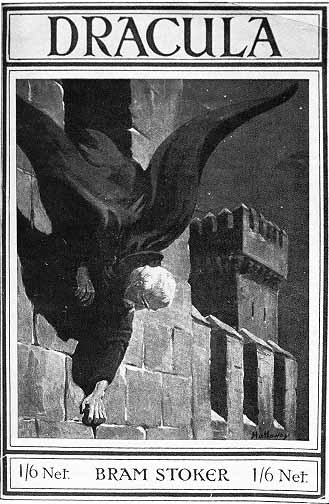
Penguin are running a design-your-own-cover project for seven of their classic titles (Amy, this sounds like your sort of thing), and have asked some folks in the music business to try their hand at it. (Only a few, though, which is a shame. Now I'll never know what McFly would have done with Anna Karenina.) Ryan Adams chose Dracula, and you can see his cover here.

Yes. It's very... oil-painted, isn't it? And quite, um, orange. Maybe Castle Dracula was built on sandstone. (Not, I should point out, that I want to criticise the supremely talented Mr. Adams, who I've loved since back when he was the singer in Whiskeytown. I love McFly, too, but for completely different reasons. They're just so sweet.) But it's interesting that neither Ryan Adams nor anybody else depicted a scene from the novel itself. The best-known Dracula cover is, I'm guessing, this one, illustrating one of the most famous images in the story (and managing to solve the problem of how it's possible to crawl down a castle wall without one's cloak falling over one's head, too: convenient up-draft). Most of the modern editions go for visual representations of characters or scenery.

I had half a theory that the earlier editions concentrated on vampires or Transylvania while the more recent ones emphasised something about Victorian England instead (compare, for example, this 1902 cover ('Joseph of Arimathea meets White Fang') with the more recent Broadview edition), but I don't think that's the case, either. And even Ryan Adams, who told the Guardian that the novel's all about "how suffocating the Victorian times were", picked the Transylvanian castle for his cover. (Actually, in his own words: "Dracula's headquarters, his hang." Ryan, I still love you, but we need to talk.)

Books we associate with a particularly strong visual image seem to come packaged with that image on the front a great deal of the time. I doubt it's a coincidence that the Dracula editions tend to go for Dracula greeting Jonathan (who isn't usually in the picture), Dracula climbing down the wall, or the shape of the castle itself. A lot of that, I'm guessing, has to do with the most striking scenes of the various Dracula films - even if you don't have Bela Lugosi or Christopher Lee on your cover, everyone knows that's what Dracula looked like when he met Jonathan for the first time - but there's more to it than that, I think. And while I don't know nearly enough about the history of the publishing industry to take any guesses at why cover illustrations of particular books tend to be more abstract (or at least, less likely to illustrate an image described in the story itself) than they used to be, I do think it's interesting that the front covers which show a grinning Dracula or a many-turreted castle seem less literary than the ones which show blurry figures or swirly oil-painted outlines of buildings.

(That said, there's no guarantee that our most vivid visual impressions of a novel will turn out to be something represented within it. Take the recent Jane Eyre illustrated by 'Dame Darcy'; the cover shows, according to the artist, "the scene where Jane Eyre is freaking out while the giant mansion is burning behind." (See Bronteana for more of that interview.) Er, yeah. It reminds me of that conversation from Blackadder:
"After all, did not Our Lord sent a lowly earthworm to comfort Moses in his torment?"
"No."
"Well, it's the sort of thing he might have done.")