'A few more Words on University Reform'

Posted by September Blue Monday, 18 June 2007 1 comments

(Blackwood's, Dec. 1853)

It is of little avail now to question the legality of the expediency of the Royal Commission; whether we like it or not, it is now a great fact – like the repeal of the Corn Laws, or the cholera.
University reform was a hot subject in the middle of the century, after the Prime Minister (at that time John Russell) set up a Royal Commission of Inquiry into Oxford in 1850. Oxford and Cambridge operated quite differently to the newer British universities, and prospective reformers were drawing contrasts in particular with the Scottish universities, which tended to be more accessible, more secular, and have a much better record in more 'modern' subjects like medicine. The fuel for reform had been building up for a long time before the 1850s, though. The Edinburgh Review was criticizing Oxford and Cambridge in the early 18th century, and with reason. See this review (it's a JSTOR link) of a book on the history of university reform by one A. I. Tillyard for a good example of why:
[B]etween 1650 and 1800, as a result of public indifference and of an evil constitution, Oxford and Cambridge lost all their older prestige and became almost useless as organs of national education. To quote Mr. Tillyard:
A period of lethargy set in, during which Oxford fell to almost incredible depths. The old examination system had become obsolete, and nothing had been put in its place. Wenedorn, who traveled through England before 1788, gives an amusing account of what he saw. The Presiding Examiner, the Respondent or candidate for a degree, and the three Opponents came into the schools, and amid profound silence passed the statutory time in the study of a novel or other entertaining work. Oxford in fact gave its degrees without any examination to all who had paid their fees and kept the required number of terms. Cambridge was saved from falling quite so low by the influence of Sir Isaac Newton and his successors. It required a certain amount of mathematics before granting a degree.
Things had changed a little by the 1850s (Oxford introduced exams in 1800, for example), although not enough to avoid the eventual reforms. But back to the Blackwood's article, where the Royal Commission's report is meeting with some disfavour for not going far enough.
There are abuses on which the most careless undergraduate could have borne important testimony, and which every honest tutor will confess with pai, on which this Report evinces either the strangest insensibility, or the most perverse conservatism.

First, and most prominent, as regards the studies of the place, stands the crying evil, which might almost have claimed a Commission to itself – that the real work of the University is done by private tutors. How tenderly and delicately the Commissioners deal with this – which we are surely not singular in considering a gigantic anomaly – may be seen by those who have the patience to read page 89 of their production. Fondly placing in the foreground, in the ardent works of Mr Lowe – himself an able and successful private tutor – the "manifold advantages" of the system, they touch lightly on its defects, and faintly hint at partial remedies. Admitting that "the amount paid for private tuition by many individuals far exceeds that which is paid for college tuition" [...] they congratulate themselves upon the fact, that the practice is less general at Oxford than at Cambridge.
But still pretty pervasive, according to the author, who speaks of it as so widespread at Oxford that 'the veriest freshman [...] must laugh in the face of her Majesty's Commissioners." (And did anyone else think 'freshman' was a uniquely American term, by the way?)
But let us examine matters more closely, and we may discover some of the causes of this remarkable state of things. Our friend [the hypothetical student], whom we have matriculated, is, we will assume, of modest acquirements, and proposes (under the old system) to take up for his degree, Herodotus, Virgil, portions of Cicero, and four plays of Euripides. But the lectures which he has to attend (for he seldom has much choice of his own in the matter) are one in Livy, one in Horace, and one in Plato's Republic; in which latter college tutor No. 1 is supposed to be great, having edited some new readings. All very desirable subjects, no doubt, but not exactly what he requires at present. [...] Or, granted that he is fortunate enough to be in a Herodotus lecture; he gets through five chapters in an hour, thrice a week, in a class of seventeen, including one freshman who cannot construe a line together decently, and stutters into the bargain, and another from the sixth form at Eton, who rattles it all off in a tone perfectly inaudible to any one except himself, and, it is supposed, the tutor. Why, at this rate, it will take him about two academical years to get through the five books of the old historian in which he is to be examined! If he be a candidate for high honours, the case is just the same, or even worse; either there are no college lectures on the subject in which he needs special assistance, or they are attended by such an ill-assorted class, containing men of all grades of scholarship and no scholarship, that he either cuts them altogether or goes to them with disgust, and brings away from them little of more value than a leading-string abstracted with much patience and vigilance from his next neighbour's gown, or a series of bad pencil-caricatures of the tutor.
Class sizes of seventeen at Oxford are huge compared to the current system, where tutorials are made up of only a couple of students at a time. For those of us with bigger classes, though, the image of nineteenth-century students bored out of their minds and doodling cartoons of the tutor is close enough to home that my first reaction to this was "well, maybe if they hadn't been skipping lectures, they'd have more to say." Kids these days, etc.
It is hard to judge, from what college lectures are, of what they might be, if they were attended in a different spirit. [...] Once let the pupil think that his teacher cannot teach, and let the teacher know that he thinks so, and it is true – he cannot. On this point Mr Foulkes, himself a college tutor, speaks with equal sense and honesty. "Pupils," says he, "make light of their college lectures in comparison with those of their private tutor; and college tutors, finding their lectures ill got up or remembered, are apt to grow apathetic, and relax in their diligence." They were more than mortal if they did not. A dull audience, the Commissioners confess, may make even a professor dull; – to borrow an illustration from the Report (which has throughout a tendency to the poetical), a tutor with an inanimate class is "Pyrrhus" without "his Epirots" – an eagle with clipped wings.
Among other criticisms, academics don't work hard enough:
At all events, there will always be an abundance of ripe scholars and sensible men, to whom the social position, and the congenial work, even with the present modest emoluments of a college tutor, will be an object quite sufficient, even if, in this active age, we add a little to their work. An extra early hour in the morning – say from eight to nine – would be a wonderful incentive to the energies of many a freshman, who is now hugging himself every morning in bed with the comfortable reflection, that in his new sphere he is emancipated from the odious "first lessons" of Harrow or Eton. Another hour in the evenings devoted to Horace or Aristophanies – say three times a week – would hardly interfere with those pleasant dinner-parties, or social cup of coffee, to which the tutor naturally looks as the reward of his labours, and with which we are sure it would be rank ingratitude for any stranger to intermeddle, who has been welcomed, as all strangers are welcomed, to those classic hospitalities.
Teaching needs to be reorganised:
Let this plan only be tried; let some college, now considered inferior, select and pay a couple of first-rate tutors, and let them form their classes according to their own judgment, selecting those departments for which each feels himself best qualified, and really working them. We will not ask of them twelve, ten, or even six hours a-day: much less will give an among of genuine instruction sufficient for the limited numbers which any one of the smaller colleges can expect to supply as candidates for honours. [...] They will be fully competent to do all which private tutors now do, if it is distinctly understood both by undergraduates and their friends that they, and they alone, are to do it.
And finances could be better arranged:
From forty men [i.e., students] paying, as we have suggested, £20 per annum each, we have £800 to apply in this manner [of paying tutors]; to which the college may well add another £200, sinking, if it may be necessary, as it seldom would be, a fellowship for this purpose. In the larger colleges, where more tutors are required, the funds will increase in proportion. This will allow, even in small colleges, at least £300 per annum to a first-rate tutor, in addition to the fellowship which we may naturally suppose he will hold on his own or some other foundation. And this, we repeat, will be enough to secure good men, and men whose energies are young and fresh; for we cannot agree with the Commissioners in thinking that the succession, by which a college tutor quits his work for the "expected living," and thus makes way for his juniors, is in itself an evil; or that it is not far preferable to the system of married professors, who will stick to their chairs, if not to their work, long after the "solve senescentum" might be fairly applied.
The reference to marriage here is because celibacy was usually a prerequisite for a fellowship (although not for professors). Smile, TAs and junior staff everywhere: we could have it worse. As for the money, according to this spiffy currency converter, that's the equivalent of about £1400 for tuition per annum, leading to a total pot of about £55,000, to which the college would add another £13,500, and end up paying tutors around £20,500 per year on top of the fellowships they'd continue to hold.


Library in summer

Posted by September Blue Monday, 11 June 2007 3 comments

This is just to say:

I have reshelved
the psychology textbooks
that were behind
the sheet music

and which
you were probably
saving
for next semester's exams.

Forgive me
their own shelves missed them
and it's eight thirty in the morning
and since I can't blame you
for the weather
or my headache
or the dust in the Government Publications section
(which is now all over my jeans)
or the pizza
half-eaten
lying next to the microfilms
this will just have to do.

'Examiners and Candidates'

Posted by September Blue Saturday, 9 June 2007 0 comments

(Cornhill, November 1884.)

I'm going to let most of this go without comment, because it really doesn't need any. While the examinations in the title are Civil Service, some things transcend that kind of context, and the piece itself begins with a wonderful portrait of an age of academia that's long gone now. Well... maybe.

It happened on this wise. I had just taken my degree at Oxford, and, elated by the full sleeves of my bachelor gown, I naturally felt that a career of triumph was in store for me. Still, at the moment, I had not settled the plan for my life-campaign. In fact, my degree had come a little earlier than I had expected. The betting in the best-informed circles had been three to one against my passing my Second School when I did. However, I had passed it, had discomfited the bookmakers, and was now at one and the same time enjoying my triumph and casting about in my mind what I should do next.

At this juncture I received a message from the president of my college, requesting my attendance. There was nothing unusual or alarming in this. At an earlier stage in my academical career it would have been disquieting in the extreme, the president being a Deus ex machina whose intervention always meant some unlucky tangle in undergraduate affairs. Now, however, though still nominally in the pupil stage, I had practically got beyond all such dangers. And I knew that the president was in the habit of sending such a message as I had received to every fresh-fledged graduate.

So I accepted the invitation without any special fear, and with only that general, undefined uneasiness which one cannot at once cast of with one's undergraduate's gown. And yet, as I had often noticed before, anything less awe-imspiring than our good president it would be difficult to imagine. It must have been the divinity of his office that made him formidable, for the man himself was exceptionally meek and mild. It is true he was constructed on a somewhat large scale, but he was physically flabby, whilst he had but little power of moral self-assertion. His health was indifferent, his voice was always tremulous, and he spoke sometime with a positive stammer. His learning was popularly supposed to be of the profoundest order. Certain it is, he devoted almost all his time to reading, getting up at six o'clock summer and winter to pursue his studies the more effectually; but as far as I know, nothing came of it all. He had never published a line, and for many years past had not delivered a lecture, and I never noticed that he threw the slightest new light on anything in conversation.

He was engaged in poring over a dingy folio as I entered his study. He had started a little when I was announced, but the start had not been strong enough to tear him from his book. At last I ventured to cough.

'Oh! – ah! – yes; I beg your pardon,' he said, looking round and forcing a smile. 'I was thinking of something else at the moment.'

He seemed to still be thinking of the something else, for his eye had a very vacant expression. However, by degrees it gathered a little more meaning, as he advanced towards me, holding out his hand.

'I have to congratulate you, Mr. Melrose, on being how a graduate. Let me see; you took honours, I think?'

The question did not strike me as a happy one, as I had to answer it in the negative.

'Just so,' said the president, a little confused. 'I must have been thinking of some one else. No doubt it is a good thing to take honours; but, after all, there are various positions in life for which they are not essential.'

'I hope so, sir,' I said. The president's remark struck me as being deficient in breadth.

'By the way,' he resumed, 'I remember now what I wanted to see you about. You will, I suppose, be looking about for something to do. Or have you some plan already in view?'

'No, sir,' I said, 'I have nothing at all in view.'

I might have added –'except enjoying myself a little,' but I was mercifully preserved from saying this.

'I wonder,' resumed the president, dreamily, 'whether this would suit you. I don't profess to understand it, but you seem to be just what they require.'

It was clear to me that the president was pursuing his own line of thought, and in fact had got pretty well to the end of it before I had reached the beginning. So I pulled him up gently.

'I am afraid I do not quite understand, sir.'

'Quite right – quite right, Mr. Melrose. I had almost forgotten the letter. Where can I have put it? Never mind, however, I think I can, perhaps, explain it sufficiently for you to – to – do what you think best in the matter.'

I bowed expectantly, and the president went on:–

'It seems that for some of these Civil Service Examinations they want sometimes additional examiners. I presume the ordinary staff is not sufficiently large – there is so much economy nowadays, especially in everything connected with the Government. Perhaps it is hardly worthy of a nation such as ours. However, it is in this way that the opportunity arises.'

The president stopped, as if he had fully delivered himself of his message. But it was still a little obscure to me.

'Do I understand, sir, that the Civil Service Commissioners require my help?'

It was unintentionally a conceited way of asking the question, and I could see that even the president noticed it, for he half smiled as he answered:–

'They do not ask for you by name, Mr. Melrose; but one of the officials, Mr. Guy Sinjin, an old member of this college, has just written to me to ask if I know of any young men who have just taken their degree and would like to help in this way.'

'I wonder if it's hard work,' I said.

The president did not like the remark. All his life he had been an example of hard work and of its occasional inutility. Something like a frown gathered upon his placid features. I hastened to divert his thoughts.

'I suppose,' I said, 'there is some remuneration?'

'The remuneration,' answered the president, with unusual emphasis, 'is paltry – quite unworthy of a Government like ours. I was struck by it, I remember, when I read Mr. Sinjin's letter. Fifteen shillings a day! Shillings always seem to remind one of artisans. Nothing under a guinea should be offered to a gentleman.'

'Or accepted by him?' I asked, for I was not captivated by the prospect set before me.

Then something of the innate paternal goodness of the president came to light. He actually laid a hand – very timidly, it is true – on my shoulder.

'Believe me,' he said, 'anything is better for a young man than idleness. If you have nothing else in view, it can do you no harm to help these people.'

There was just a tinge of contempt in the tone in which he spoke of Her Majesty's Commissioners. The fifteen shillings a day had left an uncomfortable feeling in his mind. But I was touched by his kindly interest in myself, and I made up my mind on the spot to place my valuable services at the disposal of the Commissioners. The country should not suffer though the lack of my assistance.
Anecdotes about the exams and candidates themselves below the fold.

Obeying the instructions I had received, I began prowling about among the candidates, quite resolved, however, not to catch any prey if I could possibly help it. My own examinations were still too fresh in my recollection for me to feel anything but sympathy for these unhappy victims of the great education craze. But I soon discovered that the prowling was not without its dangers to myself, ignorant as I was of official etiquette. It is a well-known fact that examination-papers, which are set with the well-known purpose of testing the accuracy of students, are themselves, as a rule, models of inaccuracy. There is some excuse for thise. Such papers are always printed as short a time as possible before the examination. There is some excuse for this. Such papers are always printed as short a time as possible before the examination. In fact, at some of our examinations the candidates arrived before the papers. Thus there is always a hurry in connection with them, and in consequence they furnish almost as rich a harvest of grotesque mistakes as the papers of the unsuccessful competitors. The German paper bristled with appalling absurdities, which might well have made the most sanguine candidate despair of ever getting through it with unimpaired sanity. I noticed how the poor fellows were racking their brains, but, as they had been brought here for the torture, of course I could not interfere. That was a matter they must settle for themselves with their enlightened country.
After the German and French papers had been done, or left undone, as the case might be, we had a most amusing scene, enacted under the name of English Dictation. No one then present in the room being considered competent to deliver himself of this dictation effectually, a hunt was made, apparently in some remote corner of the building, for a specially dictatorial examiner, who, after a while, appeared with an air of much importance. It almost seemed as if he were kept in a separate room for his voice to accumulate. This gentlemen either was at that time, or had been at some previous time, a clergyman, and was supposed to have acquired in the pulpit a strength and purity of intonation impossible to the thin-voiced haunters of pews. I must do him the justice to say that, as he was a man of high culture and gifted with a splendid voice, I can quite believe that he was a very effective preacher. But a conscientious desire to discharge his duty to the Civil Service Commissioners had developed in him a style of reading seldom heard in any pulpit. The fact was, he was over-anxious to give exactly the right sound and emphasis to each individual syllable. Take care of the syllables and the words will take care of themselves, was apparently his maxim. Moreover, the official custom of reading the sentence over twice, and pausing at different points in the two readings, gave to it something of the nature of a dreary, monotonous catch. Add to these drawbacks a decided echo in the room, and you have some idea of the difficulty of the task now set before the enfeebled survivors of the German and French papers. Sitting at the farther end of the room, I was aware that a gentleman on the platform was engaged in the most painstaking manner in shouting out some resemblance of an articulate language, but the sentences themselves were incomprehensible to me. I remember catching something about 'Fred,' followed, as it seemed, by a sneeze in sections, and then the word 'mate,' and I could not help wondering at the selection of such a colloquial piece of English composition. Upon referring afterwards to the printed paper, I found that the opening sentence ran somewhat as follows:–

'Alfred's achievement in this respect is difficult to estimate,' &c. &c.
There follows a short interlude in which he hears 'muttered sounds as of rebellion in my immediate neighbourhood', followed by a cry from one of the candidates of 'It's all bosh; it's impossible to make it out!' The actual commissioners themselves ('the Celestials') have arrived at this point, though, and when they grant his request to be allowed to sit closer to the speaker, everyone decides they want the same, and 'a physical competition for seats took the place of the mental competition for appointments'. Once quiet is restored:

As all examinations are conducted on the principle of regarding candidates, like Siberian convicts, as nameless numbers, there is no greater abomination to an examiner than the spectacle of a candidate sitting at a desk which does not correspond to his individual number. Judge, then, of our feelings (for the moment I identify myself with the official staff) when, after the intervention and departure of the Celestials, we found that almost every candidate was in a wrong place. Mr. Smithson, returning at this juncture, was momentarily paralysed, but rapidly recovering himself was about to deliver an oblique oration as to th general wishes of the Commissioners, when he was interrupted by Mr. Everard, who explained, in a manner largely leavened with disgust, that the present imbroglio was the direct work of the Commissioners themselves. He also pointed out the ringleader – that very audacious youth with the loud voice and corresponding attire.

When we had fitted them once more with their numbers – convicted them, as it were, a second time – we turned with some interest to the official key, by the aid of which each number could be converted into a name, in order to inform ourselves as to the identity of the ringleader. Of course I am not going to reveal his name. Suffice it to say that he proved to be a young aristocrat whose father might have asked awkward questions in the House of Lords had the ingenuous youth failed to pass in his dictation.
On one occasion the candidates had the best of it. I think it was when the telegraph clerkships were first thrown open to the fair sex. An incautiously worded notice to that effect had been inserted in the papers, and the result was one never to be forgotten. On the morning fixed for the examination the whole street was packed with competitive young ladies. Far as Mr. Smithson's eye could reach, there was nothing but one serried mass of hats and bonnets and parasols! They stormed the office, or, more literally, flooded it, leaving no nook or cranny unoccupied. And the cry was 'Still they come!' I was not present, but the scene has often been described to me by awestruck officials. I believe the Department, tough as it undoubtedly is, temporarily collapsed under the strain. But no one seems to know exactly what took place after the building had been stormed. This is in itself, perhaps, the best proof of the awful confusion that must have prevailed. To this day Mr. Smithson never refers to it except with bated breath.

As I have mentioned the fair sex, I will add (under shelter of anonymity) that I did not at all like the task of examining them. I deeply regret to say it, but I certainly found them much more troublesome than the competitive males. It is very difficult to maintain discipline amongst them, or to arouse in them any keen sense of the virtue of scrupulousness. I shall never forget being intrusted with the examination of certain eight young ladies. The first thing that struck me was that they had evidently arrayed themselves in their most exaggerated costumes, no doubt with the view of insinuating themselves into the favour of their judges. Though somewhat nervous and jerky in manner, it was clear they fully meant to fascinated. Poor things! they little knew the iron sternness of the Department. It was with difficulty that I got them to sit down, and with still greater difficulty that I induced them not to crowd together.
And finally:
When the paper-work was over, it appeared that no less than five of the eight young ladies wished to speak to me privately. I did not know whether to feel flattered or embarrassed by this desire. However, feeling bound to hear what a candidate had to say, I requested No. 1 to favour me with her communication. It was very lengthy, and was delivered with a great volubility. I will not attempt to reproduce it exactly – that would be quite beyond my powers; but it was to the general effect that she (the speaker) would have done her papers a great deal better – would, in fact, have triumphed over them completely – but for the circumstance that her maiden aunt, Miss Cox, who lived at No. 5, Laburnum Villas, Bermondsey, and who had brought her up since the death of her poor father of typhoid fever in the year 1867, was unfortunately very deaf, though otherwise highly talented and accomplished, and that in consequence Miss Tibbits (she had at the very beginning utterly refused to yield to my entreaty and speak of herself as a number, but had persisted in introducing herself as Miss Tibbits) had not derived all the advantages from her aunt's instruction which she would most certainly have derived under different circumstances. And she desired me, as the examiner, to take this into account, as was only fair and right, in looking over her papers.

By this time I had learnt the official formula for answering the questions of candidates. I consider that, as a piece of simple verbal mechanism readily adjustable to occasion, it deserves a patent. It runs this: 'The Commissioners alone decide on the papers, but I am quite sure that they will allow due weight to any circumstances that deserve consideration.' Isn't it beautiful? First you state an incontrovertible fact about the Commissioners, which relieves you personally of all further annoyance. And as the Commissioners are not as a rule accessible to candidates, they are not inconvenienced. Then you proceed to convey a little temporary consolation to the wounded spirit of the candidate, without committing yourself in the least. That keeps him or her quiet and hopeful, which of course is a great advantage in an examination.
The more things change...

Bad conference behaviour

Posted by September Blue Friday, 1 June 2007 2 comments

There's a fine line, but I'd draw it at 'rude'. Impolite. Discourteous. A lot of conference behaviour which isn't exactly praiseworthy falls short of that: palming your wedding ring at the registration desk is sleazy, but not really rude; asking eighteen questions along the lines of "Could you say a little more about how your paper intersects with my research topic?" is annoying, but probably unintentional; losing all copies of your paper half an hour before your panel starts is, well, just academia; getting drunk and falling over, in whatever context, is possibly inconvenient for whoever's on clean-up duty but still not rude unless you do it during a panel. (I'm sure this has happened to somebody, somewhere.)

A lot depends on seniority, too. Planting questions in the audience, or with the chair, wouldn't usually count as rude because it's behaviour typical of people at their first few conferences, after which you realise that people usually won't go for the throat during Q&A. Presenting the same paper at consecutive conferences, especially when you know you'll be presenting to roughly the same audience, counts as rude because the worst offenders are the already-established.

The bad behaviour, then, as personally witnessed by me or immediate friends and colleagues:

+ Going over time. Again, this is mostly restricted to the ranks of People Who Should Know Better ("Congratulations! Here's your professorship, your next eighteen monograph contracts, and your loss of ability to count to twenty!"). Forgiveable when it's a few minutes over; less so when it's not only twice the length it should be, but the immediate cause of getting all snippy with the chair who's asking you nicely to wrap it up. I don't want to pass judgment on individual papers, since I've seen great speakers as well as poor ones go over time, but it's worth bearing in mind that your audience will not care what you're saying once they realise you're making them miss lunch.

+ Stamping on the dreams of the next generation. "You're doing a PhD on what? Huh. I find it difficult to believe nobody's done any work on that before." Or: "I suppose they call that cultural studies," said in the verbal tone equivalent of holding something out at arm's length between finger and thumb. Or: anything about the woefulness of the job market these days. We know. Believe us, we know.

+ Writing your paper during somebody else's. You don't need to write your paper months in advance, and you don't need to write a paper so brilliant that no last-minute thoughts can work their way in there, but even if you got so wrapped up in Garfield 2: Paws of Persia on the plane that you couldn't do what everyone else does and write your paper at an elevation of 30,000 feet, you could at least have the decency to pretend you're paying attention during other people's papers. If nothing else, make it look like you're taking notes. (An addition to this: there is no excuse, ever, for making substantial additions and revisions to your paper during somebody else's when you're on the same panel. May all your field's journals take three years to reject your articles, and may all your students plagiarise.)

+ Pretending to be deaf so that the speaker has to repeat "No, I haven't read that" loudly three times during the Q&A. I don't think this one needs further elaboration.

+ Assuming the entire room needs to hear what you have to say, unless, of course, it's something like "Excuse me, but the whiteboard's on fire." Implicit in a lot of conference activity, but only crossing the line into rude when it comes to, say, talking over the panel chair when they're trying to wrap things up, shut you up, or pick someone else to ask a question. Or, when Big Famous Speaker has decreed that she has time for three questions only, grabbing the microphone runner when questioner #3 is talking to demand that you get your chance next and time limits be damned. (Actual exchange when this happened: "Um, maybe you could try to catch [speaker] afterwards?" "It is important that everybody here hears my question.")

+ Turning up for your session only, and then disappearing. Rivalled only by the people who make the organisers' lives a nightmare by demanding all kinds of scheduling adjustments, and then don't turn up at all. This one is always a mixed blessing, because on one hand it's not like you're going to miss them much, but on the other hand oh for God's sake.

But! To be positive. Academia has its own little mutations of politeness, as well as the Bad Behaviour outlined above. My favourite story, about a certain big-name philosopher, involves a brilliant solution to the problem of how to applaud when you're holding a full wine glass in one hand and there's no nearby surfaces: she clapped just as loudly as everybody else, wine glass balanced perfectly on the top of her head.

There's something about secondhand bookshops

Posted by September Blue Tuesday, 29 May 2007 3 comments

Old books

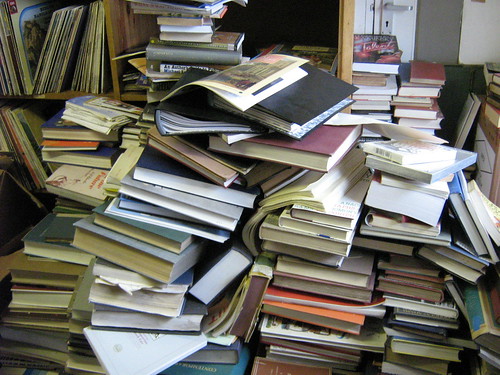
Don't you just want to reach out and touch these? Is there a single book there that wouldn't be worth looking at? And how does anyone ever make it all the way through a secondhand bookshop, anyway?

I've just spent three days in Hay-on-Wye, a tiny town on the England-Wales border that's best known now for its annual festival of literature and the arts. We made it to two and a half days' worth of the festival, but we (meaning, here, me and assorted family) were mostly there for the books. Hay-on-Wye is also the secondhand bookshop capital of, well, everywhere.

Maps

Every other shop sells books: £1 ex-library paperbacks, four-figure collectors' items, obscure fiction, obscure non-fiction, 1930s pulp fiction and leatherbound books called Ants and their Ways. There are over thirty bookshops in a town centre you can walk across in ten minutes. And while the booksellers are incredibly professional, and large secondhand bookshops really do need (and have) library-style organisation by increasingly detailed subdivision of subject area, there are only so many things you can do to impose order on chaos.

Bookpile

The festival itself is held out of town these days, but about ten minutes' walk away from the town centre. Still, ten minutes is a long, long way when it's as cold and wet and rainy as it was at the weekend. There's a constant stream of people walking between town and festival in both directions, and when there's only one narrow pavement and everybody's fighting with umbrellas and trying not to get even more mud on their feet (about which, I'd like to apologise to Nobel prizewinning poet Wole Soyinka for nearly jabbing him in the throat with an umbrella spoke. Well dodged, Mr. Soyinka). With all the events being held in giant marquee tents, it even got difficult to hear the speaker over the rattling, rippling sounds of walls and roofs in the wind sometimes (speak up, Professor Schama), but my God was it worth it. A. A. Gill's impersonation of a golf ball alone made up for the ticket prices. And between events, books.

Easy Conjuring

I bought more than I can afford and fewer than I wanted, which is about right. Among acquisitions is the Ruskin book from a previous post, a seemingly brand-new copy of this for about 1/18th of the Amazon price, five George Pelecanos novels and a 1953 edition of Tess of the D'Urbervilles with photo illustrations. (According to the preface, '[a]ll but one of these photographs are reproduced by kind permission of Mr. Clive Holland who took them when, with Thomas Hardy, he visited the places described in the novel, shortly after its publication. They therefore present the Wessex scene as Hardy himself saw it. The actual place-names are given in italics.')

Not enough, of course. But you could spend Paris Hilton's inheritance in Hay, and you still wouldn't have bought enough books.

Penguins!

Ruskin on books

Posted by September Blue 0 comments

(From John Ruskin's 1872 preface to the later editions of Sesame and Lilies.)

[L]ife being very short, and the quiet hours of it few, we ought to waste none of them in reading valueless books; and [...] valuable books should, in a civilized country, be within the reach of every one, printed in excellent form, for a just price; but not in any vile, vulgar, or by reason of smallness of type, physically injurious form, at a vile price. For we none of us need many books, and those which we need ought to be clearly printed, on the best paper, and strongly bound. And though we are, indeed, now, a wretched and poverty-struck nation, and hardly able to keep soul and body together, still, as no person in decent circumstances would put on his table confessedly bad wine, or bad meat, without being ashamed, so he need not have on his shelves ill-printed or loosely and wretchedly-stitched books; for though few can be rich, yet every man who exerts himself may, I think, still provide, for himself and his family, good shoes, good gloves, strong harness for his cart or carriage horses, and stout leather binding for his books.
I have a copy of one of these later editions, printed in 1908. It's showing its age a little: the white ink has nearly rubbed off the lilies stamped on the front cover, and there's tiny burn-marks dotted across the spine. Two previous owners have inscribed their names inside, and the author of the second (dated 17.2.1949) has meticulously crossed out the first (Wed., Sept. 27th, 1911). But for £4 from a secondhand bookshop, it's in good enough condition that it'll last another hundred years.

Well, that was depressing.

Posted by September Blue Thursday, 24 May 2007 3 comments

My Masters student baby brother is getting published before I am. My Masters student baby brother.

It's different in the Sciences. It's different in the Sciences. It's different in the Sciences...

And £2.75 for postage and packing

Posted by September Blue Tuesday, 22 May 2007 3 comments

I'm selling some of my books on Amazon. It feels like kicking fledglings out of the nest, although there's no reason it should do when most of these are books I haven't read for years. Some of them, I've never read at all; Sheri S. Tepper's Beauty has been sitting on a shelf for the past eleven years, but I've never got past the first few chapters. Giving it away feels like surrender.

That's the strange thing about giving away books, too: it's not just the books I like that I hate parting with. Listing the first thirty or so on Amazon, I found myself coming up with all sorts of reasons for why I absolutely had to keep something I hadn't read since I was fourteen and didn't ever really want to read again. Stephen Lawhead's Merlin hasn't been opened in years, but that didn't stop the voice of a book-hoarding demon whispering into my ear when I picked it up this morning. "Are you sure it should go? Don't you remember reading it in that holiday in the Pyrenees? The clouds? The flowers? The summer snow? And you loved all those King Arthur stories so much? But fine, if that means nothing to you, just you go ahead and sell all your memories and your fourteen-year-old self on Amazon for £1.25..." The voice in my other ear keeps whispering about overdrafts and bookshelf space, but that's just nowhere near as romantic.

"And then my dog ate my homework, and..."

Posted by September Blue Friday, 11 May 2007 1 comments

Overheard on the bus back from campus this evening.

Student A: "...so I told my mother, and she went mad."
Student B, laughing: "Well, you really fucked it up."
Student A: "She knows... Yeah. She knows my grades are all right. My other grades. So I said I just, I don't know what happened that class, but it's - I said it's my fault, anyway. So she knows."
Student B: "So is she going to do it?"
Student A: "She went mad at me for about half an hour -"
Student B, interrupting: "You should just have said your grandmother died or something."
Student A: "No, right, because my flatmate says if you do that they ask for a death certificate."
[Student B nods sagely.]
Student A: "So she says, anyway, she says she'll write them a letter saying I'm telling the truth, but she won't do it again. 'Cause otherwise I have to repeat the whole year or something."
Student B: "She's telling them -"
Student A: "Yeah, family emergency, something. If they still don't believe me it goes to the Academic Council."
Student B: "Oh, yeah, they will. Right, I missed the exam in first year, and I told my tutor I had a drink problem - I went to his office all shaking and everything and said I had a drink problem, I hadn't drunk at home."
Student A, laughing: "Did he believe you?"
Student B: "Yeah! He gave me the number of the counselling people and everything, he was dead nice about it. He said I could always go and talk to him."
Student A, still laughing: "Aw, that is -"
Student B: "I was shaking and everything. Milking it, right?"
Student A: "Right."

Ai.

What's a nice gentlewoman like you doing in a bindery like this?

Posted by September Blue Wednesday, 9 May 2007 0 comments

Amy at Textual Tangents sent me a link to this: library fundraising via Victorian porn. As a Victorianist and a library employee (though sadly not a librarian: they're the ones with useful Masters degrees and somewhere-close-to-decent salaries), I'm impressed. Why didn't we think of this?

On the other hand, if my employers were as budget-conscious as they claim to be, they'd have already tapped the huge market among our patrons for other services. Some kind of personal shopper service for those students who skipped library induction? ("Yes, I'm afraid all our books are shelved according to an esoteric code we're forbidden to disclose to the uninitiated. I'll just consult the gods of Class-Mark, and we'll be right with you.") Direct phone calls to the semi-mythical other librarian at the patron's last library, who always used to fetch my books for me, you know, because I'm useless with all these numbers and I just couldn't find them myself and she was so helpful, and on, and on... (It's always tempting to burst into tears when people try this one: "Well, if you loved her so much, what did you ever see in me?") Personal conscience for the weasel-minded Management and Law students, who are always hiding books in other corners of the library? (There's a John Grisham thriller in this. "He was a brilliant young law student who never looked back, until the day he finally learned: when you stare into the abyss behind the Fine Arts and Architecture shelves, the abyss behind the Fine Arts and Architecture shelves stares back into you.")

Both the departments I work for (the library counts as a non-academic department) are in the middle of major overhauls at the moment. The restructure of the English curriculum has taken a lot of work and about 570,000 hours of staff time in committee meetings to get into place, but it's mostly existed off the student radar, so even though the point of the revisions is to change things in a fundamental way for the students, the students themselves won't see it as a huge interruption to their studies. The library renovations, on the other hand, are going to affect everybody, even though the explicit aim is to cause as little disruption to students as possible. We'll be shifting to a mostly closed-stacks system for a year, which is annoying but unavoidable, and every single book we own will have to be moved somewhere else. (I look forward to finding all those missing law textbooks when the builders prise up the floorboards, though.) Since we foolishly neglected to set up a Victorian sex phoneline, the budget is limited, but we seem to have an infinite supply of money for Artists' Impressions of what the renovated library will look like.

Actually, you know what the Vienna library should spend their phoneline income on? Artists' impressions of what the library will look like during the renovations. I think we'd all be better prepared if we knew what was coming in the immediate, as well as the distant, future. "And behind that pile of rubble, the student in the green shirt is windmilling his arms about in fury because it'll take four hours to get the book he needs right now, I tell you! Now! God, the librarian at his last library would never have done this..."

Tony Blair wants 50% of young people in higher education by 2010. There is discontent.

The longer version of that is more nuanced, both in the situation itself and in the political side-stepping involved in defining it. Specifying 'higher education' rather than 'university' allows for more wiggle room in terms of vocational and semi-vocational courses, many of which aren't university degrees in themselves. 'Young people' are the under-30s rather than just the school-leavers, so someone in full- or part-time work whose employer was willing to fund them through a relevant short vocational course would count alongside the 18-year-old going to Cambridge. Defined this way, we already have over 40% participation in higher education today.

The discontent is coming from several directions. Institutions grumble, justifiably, over not having the resources to give all these new students a place. The population as a whole grumbles because university education is getting more expensive at the same time as getting more important for the job market. And university staff grumble because God, we'll have to teach these kids, don't we have enough apathetic semi-literate slackers who don't belong at university already?

(Okay, we don't phrase it quite like that. But the sentiment's there.)

I'm split on this issue. On one hand, I don't like teaching apathetic semi-literate slackers much, and it's difficult to argue that increasing the number of under-30s in higher education won't bring in more students who wouldn't have been seen academically as university material in previous generations. On the other hand, I don't think those two things are necessarily related. At the very least, they're not cause-and-effect; 'students who aren't academically excellent' and 'students who don't want to be in the room' are separate, if overlapping, groups.

To give one example, I have a lot of students who can't use commas. I can grumble about it not being my job to teach them this, and, well, in an ideal world it's not, but in this world they and their misplaced commas are in my class. Now, inadequate comma use isn't a sign of low inherent ability: nobody's born knowing how to use a comma, and they can learn now if they weren't taught in primary school. The problem isn't with students who can't use commas, but with students who can't use commas and don't want to learn how. There are ways of teaching punctuation to people who don't know the rules, but how on earth are you supposed to teach it effectively to people who don't care?

So far, growing participation in higher education hasn't come from us getting more bright kids from across the social class spectrum, but with us getting more kids from better-off families. University is becoming something you do - something you're expected to do - when you leave school. The don't-care students aren't here because they want to study one subject in particular depth, but because they want the bit of paper with a degree printed on it. As degrees become more universal, it's the absence of a degree that'll make you stand out (and not in a good way) in various parts of the job market. My don't-care students see the education itself as a necessary evil.

As for the issue of inherent academic ability: well, I'd rather teach a class of students who had no idea what a comma was but always did the reading and always had something to say in discussions, than a class of students who could do the work standing on their heads but who sulk all through the course. Give me the don't-knows over the don't-cares any day.

There's a wider issue here about university and the class system overall, too. You, as a hypothetical eighteen-year-old student of professional parents, are currently about five times more likely to go to university than you would if your parents were unskilled workers. That's not hereditary intelligence there; that's something else. A university degree doesn't just mean you have the brainpower to cope with higher education.

Getting more young people into higher education doesn't necessarily mean we'll end up with more don't-cares than don't-knows, but changing our cultural expectations of university to mean 'that place you go to when you're eighteen if you're one of our sort of people' does. And if there's one group of students who shouldn't be at university, it's the ones who don't want to be here.

'Animal Autographs'

Posted by September Blue Thursday, 3 May 2007 0 comments

(Punch, Dec. 21, 1875)

There is a Book announced under the title of Animals Painted by Themselves.

The Fox is the only animal we know of who possesses a brush, but whether he can paint with it we have yet to learn. But this is, of course only our little joke, which we must have: we know perfectly well that the title may be taken figuratively. The headings of the chapters no doubt will be more or less (more, perhaps) as follows:-

The Lion. - King of the Beasts - Much recieved in Society - Adored by the Ladies - Never met Gordon Cumming - Paws soft and effeminate - Naturally mild and philanthropic.
On (Roualeyn) Gordon Cumming, and why lions would deny ever having met him, see his mid-century Harper's articles on man-eating lions.
The Bear. - Elegant Action of - Agreeable Manners - Charming Tenor Voice - Fond of Waltzing - At the Head of the Pole - Has a Hug for every Friend.

The Fox. - Naturally frank and open - Would not hurt a Chicken for Worlds - Always liked Sour Grapes - The Best Friend with Hounds.

The Pig. - The Victim of Slander - His Clean Habits - His Sweet Home - His Abstemiousness and Remarkable Temperance - His Plaintive Warble, and his Love of Hebrew.

The Ass.
- His Musical Talents - His Tender Lips - Activity in Bondage - Willing Acquiescence when Asked to Gallop.

The Monkey. - Greek Type Developed - Superiority to Man - Dramatic Powers. &c., c., c.

The Work promises to be most amusing, if not instructive. We only hope it will be illustrated by Animals. Why not? Badgers have been most successfully drawn by Dogs; and few Horses but have drawn a carte de viste. So we repeat, Why not?

Notable things the dog has eaten or severely chewed on recently:

Posted by September Blue Wednesday, 2 May 2007 1 comments

- Packet of blackcurrant-flavoured Lockets
- Two undergrad theory textbooks
- Pair of glasses
- 1960s science fiction anthology edited by Ray Bradbury
- The kitchen floor
- The hall carpet
- Book on poverty and welfare reform laws
- Arms, legs, ears, head of toy rhino
- Pair of prescription sunglasses
- The cushion she sleeps on
- The blanket she slept on before that
- The skirting boards in the hall
- Assorted letters, envelopes, pieces of junk mail
- Single slipper

One day we're going to come home to the little, gnawed stump of a house, the dog lying next to it with her best mournful A Big Dog Did It And Ran Away expression.

| edit post

'Some Sea-Serpents, Original and Selected'

Posted by September Blue Friday, 27 April 2007 1 comments

(Cornhill, March 1886.)

No doubt the sea-serpent, like most other animals, has varied a little from time to time, and has been affected by the Darwinian principle of survival of the fittest, in proportion as the credulity of the sea-serpent-observing world grew less and less. Still, the monsters that devoured Laocoon possessed in very full perfection all the 'points' that ought to distinguish a perfectly thorough-bred and first prize sea-serpent. Their heads and shoulders were raised (in the most orthodox manner) high above the waves, while their bodies trailed behind upon the surface, rising up in an undulating fashion here and there between the foaming billows. They had a bristly mane upon their necks; and it is well known that a good mane is highly desirable, or even absolutely indispensible, in the get-up of a successful sea-serpent, to this very moment. They were more or less blood-stained and fiery creatures; and the original and only genuine medieval portent went so far as actually to belch forth flames and black wreaths of smoke from his mouth and nostrils. This last alarming feature, however, has been greatly mitigated in his modern representatives, who now don't care, apparently, to put themselves into competition with an ordinary locomotive, and so content themselves with making the sea boil, and spurting out foam from their unspeakable blowholes (if any).
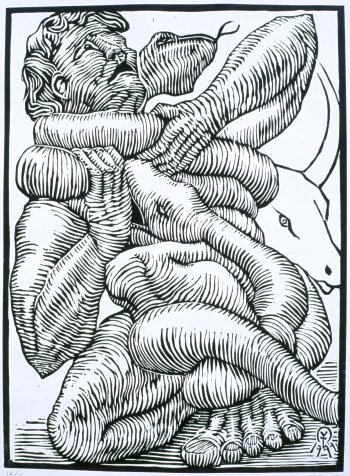
Abbreviated Aeneid: Laocoön told the Trojans to beware of Greeks bearing gifts, threw a spear at the wooden horse when they didn't believe him, and Poseidon sent sea serpents to kill Laocoön and his sons.) There's a gorgeous woodcut of Laocoön wrestling with the serpent here (by Daniel Biehl).
There are a good many theories now extant about the semi-mythical monster, which have been defended with varying ability by various learned men. Mr. P. H. Gosse was of opinion that the sea-serpent (if there be a sea-serpent) was a modern representative of the otherwise extinct saurians, who enacted the part of whales in the teeming secondary seas. Whether any of these big dragons of the prime have really left any descendants or not, there can be no doubt at all that they were certainly very parlous monsters in their own day. Naturally, the biggest things in such extinct reptiles have been discovered in the Western States of America, which whip creation for big trees, big rivers, big fossils, and big fortunes. One of the most disconcerting creatures to meet a yachting expedition in cretaceous seas must evidently have been that uncanny beast from the Colorado beds, which Professor Geikie soberly describes as 'a huge snake-like form, forty feet long, with slim, arrow-shaped head on a swan-like neck, rising twenty feet out of the water.' According to Dr. Cope, who has closely studied the habits and manners of this unpleasant animal in his native rocks, the monster must often have swum several yards below the surface of the sea, only occasionally popping up his head for forty feet to take a breath, and then withdrawing it to feed forty feet below on the bottom, without once moving the position of his body. Such an unaccountable saurian as this, suddenly rearing his 'swan-like neck' (as if he were a noble Anglo-Saxon lady) within a few yards of the observant pleasure-boat among the Inner Hebrides, would create a far greater impression than any that can be produced by the degenerate and somewhat shadowy krakens of these prosaic latter days.
I think that's a plesiosaur, and if plesiosaurs interest you at all, even a tiny tiny little bit, then you need to read this story by Wardon Allen Curtis. That's a link to the e-text, which is illustrated. I don't want to give away the ending, but I will share one brief passage with you, written shortly after the narrator removes the brain from the still-living elasmosaurus (a species of large plesiosaur) Because It Was There and realised that his friend Framington was dying. Ask not how he found a plesiosaur in the first place; linger not on what happened to Framington; just wallow, for a moment, in the kind of thought process that could bring you this:
"If you hear me, wink," I cried [to Framingham]. The right eye closed and opened with a snap. Ah, here the body was dead and the brain lived. I glanced at the elasmosaurus. Its mouth, half closed over its gleaming teeth, seemed to smile an invitation. The intelligence of the man and the strength of the brain. The living body and the living brain. The curious resemblance of the reptile's brain-pan to that of a man flashed across my mind.
I won't tell you what happens next, although you can probably guess. Scientists, eh? Anyway. Back at the Cornhill article, we're talking about 'pythonomorphic saurians'. More of that below the fold.
[...] I am not aware that any modern theorist has yet proclaimed the identity of the various scattered sea-serpents of our own day with the pythonomorphic saurians; but if any enterprising young writer cares to act upon the hint in the silly season, when Parliament has ceased from troubling, and reporters are at peace, he is perfectly welcome to accept the suggestion without further acknowledgement.

Mr. Searles V. Wood, on the other hand, will have it that the sea-serpent (supposing there is a sea-serpent) is not a reptile at all, of what sort soever, but a whale-like monster, belonging to the same group as certain extinct toothed whales who flourished (as the history books say) in the eocene period. The particular part, in fact, which they flourished most effectively, according to Mr. Wood, was their formidable head; and with that they (as well as all their hypothetical heirs, executors, or assigns, the modern sea-serpents) were wont to attack less warlike whales, whom they killed and devoured with their big teeth. These undeniable eocene monsters ran to about fifty or sixty feet in length, and were certainly provided with most carnivorous fangs, sufficient to render them very unpleasant contemporaries for the other whales who lived side by side with them. Several of the most respectable authorities believe that the toothed cetaceans in question were really (to put it plainly) big seals, caught in the very act of developing into thoroughgoing whales. They are, by origin, warm-blooded, air-breathing, terrestrial animals, which have taken to the habit of swimming, till at last their outer form has come closely to resemble that of cold-blooded, gill-bearing, egg-laying fish. Mr. Wood has set forth his very hypothetical views with an air of sober conviction which is quite charming in its simplicity, and has assigned the as yet undiscovered sea-serpent to the 'order Zeuglodontia,' almost as confidently as though he had got a specimen or two of the evasive monster securely bottled for examination in his own private museum. On the whole, it might be better to follow Mrs. Glasse's admirable advice, and first catch your sea-serpent.
Zeuglodonts were early whales. One of them, Basilosaurus, achieved brief fame in the early 21st century with the BBC series Walking With Beasts, and has a picture here along with a great profile: "Length: 20m. Diet: Omnivore. Predators: Probably none." No, really, you think?
[...] Now, the question is, could one of the forty-eight known species of sea-snakes ever attain sufficient dimensions to have given rise (allowance being made for human exaggeration) to the best recorded instances of the great sea-serpent? Bishop Pontoppidan's specimen, seen off Norway in 1740, was one of the finest on the record, and measured about 600 feet in length. On the other hand, the biggest sea-snake known to Dr. Gunther of the British Museum (the great authority on things reptilian) is only twelve feet long; which leaves a considerable margin for the bishop's specimen to make up, even under the most favourable circumstances. Again, the very notable beast spied off Boston, Massachusetts, in 1819, is described with a noble and poetical vagueness as being 'from 80 to 250 yards in length;' which reminds one of the ingenuous advertising dodge, whereby shopkeepers announce that a lot of goods, worth obviously on an average five pounds apiece, are 'from one shilling.' In 1822, a second sea-serpent, spied off the Norwegian coast, was again calculated at 600 feet long, which seems a suspicious reminiscence of the father of all sea-serpent seen by Pontoppidan. Captain Drevar's great snake, which coiled itself twice round a sperm whale, was of indefinite length, but as it raised its head 'some sixty feet perpendicularly in the air,' its total extent must have been pretty good for an overgrown sea-snake.

There can be no doubt that certain kinds of animals do really produce at times abnormally large individuals; and this is particularly the case with fish and reptiles, where the size of the different adults always varies greatly with varying circumstances. Everybody knows that a full-grown trout may be almost any size, big or little; while as for pike, Mr. Frank Buckland records the biggest he ever saw as being no less than 3 feet 10 1/2 inches long. Still, the amount of lee-way that a twelve-foot sea-snake has to bring up before it reaches the 600 feet of the Norwegian specimens, or the 750 of the Bostom champion monster, is really too immense to be readily granted by sober reasoning. Moreover, it is a curious fact that sea-serpents should be most frequently seen in the North, while sea-snakes are almost confined to the tropics. Why do the gigantic growths always come northward, to the exact spot where they may be seen by credulous Norwegians and wonder-loving Americans? Is it not just a trifle significant that these portents are oftenest beheld by the superstitious Norse sailors, and the still more superstitious Celts of the west coast of Scotland?
We go on to discuss giant squid (called simply 'big squid' here, which does have a certain something going for it here as far as snappy names go). Dead giant squid had been washing up on beaches throughout the nineteenth century, but there were also accounts of live squid. They don't make holidays to Tenerife like this one these days:
Very recently, the big squid has become quite a respectable scientific character, and has been duly admitted to our natural histories under the specific titles of Architeuthis monachus and A. dux. When an animal comes to have a double Latin name, for genus and species, he may be considered as having fairly forced his way into good society, and attained for himself a public recognition. The first big calamary found in modern times, according to Dr. Woodward, was sighted by the French steamer Alecton, off Teneriffe, in 1861. Every effort was made to secure it; but after a long fight, the monster got away, leaving its tail behind it, in the running noose of a rope. This brute was supposed to be about eighteen feet long, with arms of five or six feet more (still a long way off from the sea-serpent). But one must remember that the salmon that got away from one is always a far larger and heavier fish than any salmon one ever actually landed and weighed in the impartial scales of undistorted reality. Perhaps the size of the Alecton's squid was computed not in British feet, but in a measure of length equivalent to that well-known angling standard commonly called fisherman's weight.
Something similar applies to wordcounts on student assignments, I think. Especially the ones with the really wide margins.

Can we conclude then, as a clever writer has lately done, that the giant squids are the real creatures which have given rise to the belief in sea-serpents? To me at least it seems improbable. I can hardly believe that any one form of sea-serpent will cover all the various myths and observed cases. I have, rather, a modest theory of my own as to the true origin and development of the entire family, which I shall proceed to set forth in the usual scientific classificatory fashion. [...]

There seem to be two grand divisions of the genus sea-serpent: firstly, those due mainly to preconceptions and superstitions, and so ultimately mythical in origin; and, secondly, those due mainly to observations, accurate or inaccurate, and so mainly genuine in origin.
[...]

The mythical sea-serpent, in my humble opinion, is by far the commoner animal of the two. His origin goes back in time to a very early period, when he and many other formidable dragons stalked abroad, unchecked and rampant, over sea and land alike. In the old English epic of Beowulf there is a very fine monster called the Fire Drake (drake being good Anglo-Saxon for a dragon), which guards a mysterious submarine treasure, and which comes out by night to slaughter the people of the royal hero. Beowulf himself goes forth, with his royal sword, to battle with this relentless monster, and slays it, indeed, by his own strong arm, but is blasted by its fiery breath, ad dies shortly after the fierce encounter. Now, the old literature of the North is full of sea-dragons of just the same type – fire-breathing krakens, which devour ships: terrible shapes, begotten of the dread and mystery of the ocean, and possessing all the ordinary mythical features of dragon-kind. It is a very significant fact that, as we go down in time, the dragons and sea-serpents of each age are, as a rule, exactly what that particular age expected to find them. In the fifteenth century a dragon that didn't breathe fire would have been quite unworthy of notice, and a mere big marine snake, with a prosaic habit of lolling on the top of the water, would have been considered not one whit better than an ordinary whale or walrus. At the present day, on the other hand, the common sea-serpent possesses few obviously mythical features, though he has still a distinct tendency to retain a mane, which, in the memorable instance of the Daedalus's monster, is significantly described as 'something like the mane of a horse, or rather a bunch of sea-weed, washing about its back.'
The HMS Daedalus was a British navy ship of the nineteenth century whose crew saw... well, a sea-serpent, obviously... in 1848. (You can read more on that, and other Mysteries Of The Deep, here.)
[...] The final question is just this: In an ocean teeming with so many known animals of huge size, ought we to set down any un-caught specimen as a new species, on a cursory examination, under eminently deceptive and unsatisfactory circumstances? And if we do, are we not in all probability more or less directly influenced by surviving memories of the great extinct krakens and fire-breathing dragons? Are we not, in short, trying to make a sea-serpent out of it? Let us rest satisfied with our big cuttle-fish and huge whales and monstrous sharks for the present; and whenever anybody catches us an enaliosaurian or an zeuglodon or an immense marine snake, let us accept their new addition to zoology with all acclamation. Meanwhile, let us urge once more on all theorists, 'First catch your sea-serpent': then proceed to classify him.

Love your research

Posted by September Blue 1 comments

I'm falling in love with an author. Not in the standard (well, standard for me) crush-on-a-long-dead-poet way, but through the kind of accidental romance that starts with a footnote and ends in chasing publishers down the street, out of breath and scattering pages behind you ("waaaaaaaaait, Mr Penguin!"), as you try to explain how Very, Very Important it is that they contract you to edit a new scholarly edition of her best-known work.

She's one of those Victorian writers who flourished for a little while and then faded back into obscurity again, and she's part of a big enough crowd in that. Still, she's worth a revival. Her writing probably won't be the Next Big Thing in Victorian studies, but it's interesting and unusual and funnier than it has a right to be, and more people should read her. Some people should read her. Anybody should read her. And if they're not reading her, they should start selling her books at prices I can afford.

She's gone from a few footnotes in my thesis to taking up most of one chapter, and she's worked her way into every conference paper I've given in the last year. I had to fight my better judgement on including an irrelevant, biographical footnote on her in an article I'm writing at the moment. My long-term research plan features her heavily, I'm already mentally drafting the next article (in which she'll feature prominently), and I'm about three weeks away from printing 'Obscure Victorian Writers ROCK!' T-shirts and setting up a campaign to raise awareness. (Would Bono help, do you think?)

Everyone needs a champion, even if the best you can get is a completely non-influential one living a hundred and fifty years too late.